





CBD and Melatonin for Sleep — Which One Actually Works?
|
|
Time to read 10 min
Buy 3, Get 2 Free | 40% OFF $200+
50% OFF $400+ | Shop Now
|
|
Time to read 10 min
The Short Answer: CBD and melatonin address completely different sleep problems through completely different mechanisms. Melatonin signals the brain that darkness has arrived and regulates circadian timing — it is most effective for jet lag, shift work, and sleep phase disorders. CBD regulates the nervous system state that determines whether sleep can begin and be maintained — it addresses the anxiety, cortisol dysregulation, and HPA axis overdrive that cause most chronic insomnia. Most people using melatonin for chronic insomnia are treating the wrong problem. The right question is not which is better — it is which mechanism matches your sleep pattern.
Table of Contents
Melatonin is the most widely used sleep supplement in the world. It is sold everywhere, taken by tens of millions of people nightly, and widely understood as the natural sleep hormone. All of this is true — and none of it means melatonin is the right solution for most people who struggle with chronic insomnia.
CBD is the compound most people are now turning to as an alternative. It works through a completely different mechanism, addresses a different dimension of sleep disruption, and has a fundamentally different clinical profile for long-term nightly use. Understanding the distinction between the two is the clinical prerequisite for using either one effectively.
Melatonin is a hormone secreted by the pineal gland in response to darkness. Its primary function is to signal the suprachiasmatic nucleus — the brain's master circadian clock — that night has arrived and that the body should begin its transition toward sleep. It does not sedate. It does not produce sleep directly. It initiates the biological preparation for sleep by shifting the circadian phase.
This mechanism makes melatonin genuinely effective for a specific category of sleep problem: circadian timing disruption. Jet lag, shift work, delayed sleep phase syndrome, and irregular sleep schedules all respond well to melatonin because the primary issue is misalignment between the circadian clock and the sleep window. Melatonin corrects the timing signal.
It is significantly less effective — and the evidence supports this clearly — for the most common form of chronic insomnia: the inability to fall asleep or stay asleep despite being in the right circadian window, driven by nervous system over-activation, anxiety, cortisol dysregulation, and accumulated stress load. This is not a timing problem. Giving a timing signal to a nervous system that is too activated to receive it does not produce sleep.
The American Academy of Sleep Medicine has noted that melatonin has limited value for treating chronic insomnia and that long-term nightly melatonin use for insomnia is not their recommended approach — with preferred interventions focusing on behavioral and physiological regulation of the sleep system itself rather than hormonal signaling.
CBD does not signal darkness. It does not regulate the circadian clock. What it does is regulate the nervous system state that determines whether the body can receive and act on whatever sleep signals are already present.
Through 5-HT1A serotonin receptor agonism, CBD reduces anxiety and the sympathetic nervous system activation that prevents sleep onset. Through FAAH inhibition, it amplifies anandamide — the body's primary endocannabinoid — which supports the parasympathetic state required for sleep. Through CB1 and CB2 receptor modulation, it addresses HPA axis overdrive — reducing the elevated cortisol baseline that chronic stress maintains and that melatonin cannot touch.
A large clinical case series published in The Permanente Journal found that 79.2% of patients showed meaningful anxiety reduction within the first month of consistent CBD use, and sleep quality improved in 66.7% of patients within the same period. These are not circadian timing improvements. They are nervous system regulation improvements — exactly the mechanism that melatonin does not address.
Melatonin's most common complaint — next-morning grogginess — reflects a pharmacological reality that is often underappreciated. Melatonin at commercial doses (3–10mg, far exceeding the physiological nighttime peak of 0.1–0.3mg) produces a sustained hormonal signal that can extend well into the morning, delaying the cortisol awakening response and producing the groggy, slow-to-start feeling that many nightly melatonin users experience.
A large-scale head-to-head comparison offers useful data here. The Radicle Discovery Sleep Study — a blinded, randomized, controlled trial of 1,800 participants comparing cannabinoid formulations to melatonin — found that participants taking cannabinoid products (including CBD and CBN) reported lower incidences of grogginess than those receiving melatonin alone. Both groups showed meaningful sleep improvement. But the daytime experience differed: melatonin's hormonal signal persisted into the following morning, while the cannabinoid formulations did not produce the same residual effect.
In a 1,800-participant blinded clinical trial, cannabinoid sleep formulations produced lower grogginess the morning after use compared to melatonin — while delivering comparable improvements in sleep quality.
Melatonin has a legitimate clinical use case: short-term circadian timing disruption. Jet lag, shift adjustment, delayed sleep phase — these are problems where the body's clock is misaligned with the desired sleep window, and a brief course of melatonin at the lowest effective dose can help reset the signal. That is what it was designed for.
What melatonin was not designed for — and what most people use it for — is chronic insomnia driven by nervous system over-activation, cortisol dysregulation, and accumulated stress load. Melatonin is a circadian timing hormone. It tells the brain what time it is. It does not quiet the nervous system that is too activated to receive the signal.
The long-term use question has become more pressing. A 2025 study presented at the American Heart Association's Scientific Sessions reviewed health records from more than 130,000 adults with chronic insomnia and found that those who took melatonin for a year or longer were nearly 3.5 times as likely to be hospitalized for heart failure and nearly twice as likely to die from any cause over five years compared to non-users. The researchers were careful to note that the study does not prove melatonin causes heart failure — the association may reflect the severity of the underlying sleep disorder rather than a direct pharmacological effect. But it is a meaningful signal, and one that should prompt anyone taking melatonin nightly for chronic insomnia to ask whether they are treating the right problem.
The answer to chronic insomnia is not a different dose of melatonin. It is a protocol that addresses what melatonin cannot reach.
CBD addresses the nervous system layer: the anxiety, cortisol dysregulation, and HPA axis overdrive that prevent sleep onset and suppress REM sleep. For many people, that single intervention meaningfully changes their sleep. For others — those with sleep maintenance problems, the 3 AM waking pattern, or the deeper deficiency that TCM identifies as the root cause — CBD alone is the foundation, not the complete answer.
The protocol builds from there based on the specific pattern:
Sleep onset and maintenance — Sleep Gummies
Dragon Hemp's Sleep Gummies deliver 25mg CBD and 10mg CBN in a single THC-free formulation. CBD quiets the nervous system over-activation that blocks sleep onset. CBN targets nighttime awakenings through partial CB1 receptor agonism — a different mechanism, covering a different phase of the night. Taken 45–60 minutes before bed, they address both layers without THC.
Formulated to ground the nervous system and invite a quiet, steady calm.
This peaceful blend of CBD isolate and CBN—ingredients selected to ease evening tension and guide your body back to its natural rhythm without THC—invites truly restorative sleep so you wake clear-headed and refreshed.
Because addressing the root of restlessness while preserving clarity is the first step toward waking as your true self.
Sleep onset difficulty alongside maintenance problems — Sleep Gummies+
Sleep Gummies+ adds 2.5mg low-dose THC to the same CBD and CBN base. At this dose THC shortens sleep latency and deepens early slow-wave sleep without the REM suppression that higher doses produce. The clinical choice for those who struggle both to fall asleep and stay asleep through the night.
Formulated to ground the nervous system and quiet a restless mind.
This precisely balanced blend of CBD, CBN, and micro-dosed THC—ingredients selected to shorten the time it takes to wind down and support a deeper state of rest—helps ease evening tension so you wake clear and refreshed.
Because guiding your transition into rest is the first step to a deeper, fuller night of truly restorative sleep.
Sleep disruptions and root-cause support — Sleep Tincture
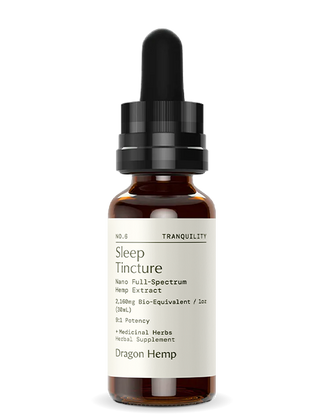
The Sleep Tincture is the most complete formula in the protocol — and the clinical choice for disrupted sleep. Nano-emulsified CBD and CBN absorb sublingually within 15–20 minutes, significantly faster than gummies, making it effective both as a pre-sleep preparation and as an as-needed intervention kept on the nightstand for the 3 AM waking.
Alongside the cannabinoids, the Sleep Tincture carries the full Suan Zao Ren Tang formula — the five-herb classical TCM preparation that nourishes Liver Blood, clears Heart Heat, and calms the Shen at the root level that cannabinoids alone cannot reach. A randomized controlled trial comparing Suan Zao Ren Tang to lorazepam in anxious insomniacs found statistically significant improvements across insomnia severity, Pittsburgh Sleep Quality Index scores, wake after sleep onset, and sleep architecture — outperforming lorazepam on multiple measures after four weeks.
The Nightly Restoration Protocol outlines how the tincture, gummies, and timing work together as a complete system.
Practitioner-formulated to restore the balance necessary for a full, deep sleep cycle.
This high-potency tincture draws from time-honored 'Suan Zao Ren Tang' formulas, blending traditional Chinese herbs—long-trusted to settle a restless mind and nourish the spirit—with nano-encapsulated CBD & CBN to target the racing thoughts and midnight wakefulness that disrupt your rest. By helping you stay asleep longer, it ensures your body reaches the deep cycles essential for systemic recovery and physical restoration.
Because a full night of sleep is about more than just rest—it’s about waking with the energy and focus to feel like yourself again.
Direct Answer: It depends entirely on the type of sleep problem. Melatonin is appropriate for circadian timing disruption — jet lag, shift work, delayed sleep phase. CBD is appropriate for anxiety-driven insomnia, chronic stress-related poor sleep, and HPA axis dysregulation. Most chronic insomnia is the latter category, for which melatonin has limited clinical evidence of efficacy.
Clinical Context: In TCM terms, melatonin cannot address the Liver Blood deficiency or Heart-Shen disturbance that drives most chronic insomnia — it only signals the time of night to a system that already knows what time it is but cannot settle regardless. CBD addresses the nervous system state. Suan Zao Ren Tang addresses the constitutional root. All three mechanisms serve different dimensions of the same problem.
Direct Answer: Yes — and for people with both circadian disruption and nervous system over-activation, the combination addresses more of the sleep problem than either compound alone. The mechanisms do not interact negatively. Melatonin provides the timing signal; CBD provides the nervous system regulation that allows the body to act on it.
Clinical Context: If combining both, use the lowest effective melatonin dose — 0.5 to 1mg, not the 5–10mg commonly sold — to provide the circadian signal without the pharmacological overshoot that causes morning grogginess. Full-spectrum CBD at 25–60mg addresses the nervous system layer. The two together, combined with CBN for sleep maintenance, covers the full clinical picture that either compound misses alone.
Direct Answer: For anxiety-driven insomnia specifically, yes — CBD addresses the mechanism (sympathetic nervous system over-activation, cortisol dysregulation, HPA axis overdrive) that melatonin does not reach. Melatonin is a circadian timing hormone, not an anxiolytic. It cannot quiet the nervous system that is too activated to sleep.
Clinical Context: The distinction matters for treatment selection. If a person cannot sleep because they are anxious and wired despite lying down at the correct time, melatonin adds a timing signal to a system that cannot receive it. CBD modulates the serotonergic and endocannabinoid pathways that govern the arousal state preventing sleep. This is why consistent CBD use produces durable sleep improvements in anxious insomniacs where melatonin produces at best modest benefit.
Direct Answer: At common commercial doses (3–10mg), yes — melatonin frequently causes next-morning grogginess because the hormonal signal persists beyond the sleep window. The physiological nighttime melatonin peak is approximately 0.1–0.3mg; commercial supplements deliver 10–30 times that concentration, producing a signal that extends into morning.
Clinical Context: A 1,800-participant blinded clinical trial found lower grogginess incidence in participants taking cannabinoid sleep formulations than in those taking melatonin alone, despite comparable sleep quality improvements. This reflects the mechanistic difference: cannabinoids regulate the nervous system state without producing a prolonged hormonal signal that carries into the following morning.
Dragon Hemp was established by Kevin Menard, LAc, a specialist in Sports Medicine Acupuncture and Traditional Chinese Medicine. Developed in his Sag Harbor clinic, our formulations bridge the gap between ancient herbal wisdom and modern cannabinoid research to address the root causes of pain, sleep, and wellness issues.
From our Rest & Restoration and Essential Wellbeing collections to our targeted Aches & Pains topicals, every product is formulated with organically grown botanicals and premium hemp extracts. We invite you to experience our sophisticated fusion of tradition and innovation at our flagship apothecary at 108 Main Street, Sag Harbor, or explore our full range of tinctures, gummies, and balms online.