


Warming Balm vs. Cooling Balm — Which Is Right for Your Pain?
|
|
Time to read 22 min
3rd Recovery Remedy Free • Code: R3COVER • Arthritis Awareness Month • SHOP NOW
|
|
Time to read 22 min
The wrong thermal formula can worsen pain. Warming herbs on a hot, inflamed joint add heat to inflammation; cooling herbs on a cold, stiff joint deepen the obstruction.
Bi syndrome is the TCM framework for all joint and channel pain: the word Bi means obstruction — pain occurs when Qi and Blood cannot flow freely through the channels. The pathogenic factor causing the obstruction (Cold, Damp, or Heat) determines the pattern and the treatment.
Both balms descend from dit da jow — the 1,000-year-old Chinese martial arts trauma medicine tradition built specifically to move stagnant Blood and reach the channel level beneath the skin.
The Warming Balm is for Cold and Damp Bi presentations — fixed, aching pain that worsens in cold and damp weather, stiffens overnight, and improves with warmth and movement.
The Cooling Balm is for Heat Bi presentations — red, hot, swollen joints with pain that worsens with activity and improves with cold application and rest.
Within 48 hours of any acute injury, always use the Cooling Balm — acute injury produces local heat regardless of the underlying constitutional pattern.
Both balms can be used simultaneously on different joints when different patterns present in different areas of the body.
The Recovery Tincture is the systemic anchor beneath both topical formulas — the daily protocol that addresses the inflammatory environment underneath the local symptom.
Table of Contents
The Short Answer: Bi syndrome is the TCM framework for all joint and channel pain — Bi (痹) means obstruction of Qi and Blood, and the pathogenic factor causing that obstruction determines the treatment. The Warming Balm is appropriate for Cold and Damp Bi — fixed aching joint pain that worsens in cold and damp weather, stiffens overnight, and improves with warmth and movement (the typical pattern of degenerative arthritis, chronic stiffness, and cold-aggravated discomfort). The Cooling Balm is appropriate for Heat Bi — red, hot, swollen joints with pain that worsens with activity and improves with cold application (the typical pattern of inflammatory arthritis, acute flares, and post-injury inflammation). Both formulas descend from the dit da jow tradition of Chinese martial arts trauma medicine — herbs selected for their ability to penetrate the channels and move stagnation, not just sit on the skin. The four-question diagnostic in this article resolves almost every case in under a minute. The Recovery Tincture sits underneath both as the systemic anti-inflammatory anchor. Within 48 hours of any acute injury, use the Cooling Balm regardless of constitutional pattern — acute injury produces local heat that the cooling herbs address directly. Both balms can be used simultaneously on different joints when different patterns are present.
The Warming Balm and the Cooling Balm look similar on the shelf. Same package. Same brand. Same 3,600mg full-spectrum hemp base. The marketing instinct is to treat them as preference-based — choose whichever one feels nicer.
The distinction is rooted in a clinical framework called Bi syndrome — the TCM category for all joint and channel pain. Bi (痹) means obstruction: pain arises when Cold, Damp, or Heat blocks the free flow of Qi and Blood through the channels. Each pathogen obstructs differently and requires a different thermal response to clear. That is what the Warming and Cooling Balm distinction is built on.
That instinct is wrong, and the consequence of getting it wrong is not neutral. Applying the wrong thermal formula to the wrong pain pattern can quietly make the pain worse.
Warming herbs applied to a Heat Bi joint — the red, hot, inflamed presentation — add heat to a presentation that already has too much. The Capsicum and Aconite increase circulation in tissue that is already inflamed. The joint flares. The swelling deepens. The pain intensifies for an hour or two before the topical wears off. Patients who experience this often conclude that "natural pain relief doesn't work" — when what actually failed was the absence of the diagnostic step.
Cooling herbs applied to a Cold Bi joint — the cold, stiff, fixed presentation — produce a different failure mode. The Camphor and Gardenia provide brief sensory relief from the cooling sensation, then the joint stiffens further over the following hours. The underlying circulation impairment worsens. The cold pattern entrenches.
This is why Dragon Hemp's topical line contains two formulas rather than one. The thermal pattern in the joint determines which formula applies. The four-question diagnostic below is how to make that decision in under sixty seconds. Before the diagnostic, though, it helps to understand where these formulas actually come from — because the lineage is the reason the herbs work the way they do.
In traditional Chinese medicine, pain in the joints, muscles, and channels is categorized under a single clinical framework: Bi syndrome (痹症). The word Bi means obstruction. The foundational premise is that pain — in any location, of any character — is the result of Qi and Blood failing to flow freely through the channels. When circulation is impaired, tissue is inadequately nourished, waste accumulates, and the obstructed channel generates pain as a signal.
The clinical question Bi syndrome asks is not just where the pain is, but what is causing the obstruction. TCM identifies four primary pathogenic factors: Wind (pain that moves between locations), Cold (pain that is fixed, worsened by cold, and improved by heat), Damp (heavy, swollen, sluggish pain with a fixed quality), and Heat (pain that is hot, red, inflamed, and worsened by activity). Each pathogen obstructs the channels differently — and each requires a different therapeutic response to clear it.
Most chronic joint pain involves a combination of these patterns. Cold and Damp typically coexist, producing the fixed, weather-sensitive, stiffening pattern that characterizes degenerative arthritis. Heat Bi reflects excess inflammation in the channel — either from an acute injury or from an underlying autoimmune pattern generating sustained inflammatory activity. The thermal character of the pattern is the primary variable that determines which formula applies. Getting this right is the entire point of the diagnostic below.
The Warming Balm and the Cooling Balm are not generic CBD topicals with Chinese-sounding ingredients added for branding. They descend from a specific lineage of Chinese medicine called dit da jow (跌打酒) — literally "fall strike wine" — the topical herbal formulas developed within Chinese martial arts traditions over the past thousand years to treat traumatic injury, break up Blood stagnation, and restore channel circulation at the site of physical damage.
These formulas were not theoretical constructs invented in a laboratory. They were developed through intensive clinical refinement in environments where practitioners — Shaolin monks, Kung Fu masters, traveling traditional doctors — treated high volumes of traumatic injury and tracked outcomes systematically across generations. Broken bones, torn ligaments, contused muscles, joint damage. The result was a body of empirical knowledge about which herbs, combined in which ratios, produced the most effective penetration through the skin to the channels beneath.
This lineage matters for one specific reason: the herbs in dit da jow formulas were selected for their capacity to penetrate. A standard topical analgesic sits on the surface of the skin, producing a sensory effect (cooling, warming, tingling) that signals the brain to perceive less pain at the site. A dit da jow formula penetrates through the dermal layers to reach the channel level — the network of meridians and microcirculation beneath the skin where Blood and Qi actually flow. Once at the channel level, the herbs do the work of moving stagnation, dispelling Cold or clearing Heat, and restoring circulation to the obstructed tissue.
This is why a practitioner-formulated dit da jow descendant produces clinical effects that generic menthol creams or simple CBD lotions cannot match. The lineage built the herbs to do work, not just to sit and feel pleasant. The full clinical and historical context for the tradition is documented in our deeper read on dit da jow as ancient martial arts trauma medicine.
The Warming Balm and Cooling Balm are the modern apothecary expression of this tradition — pattern-specific dit da jow formulas paired with full-spectrum hemp extract, formulated for the joint pain conditions the patient population we see in clinic actually presents with. The diagnostic step that follows is what allows the right formula to be matched to the right pattern.
The quick answer for the obvious cases: If the joint is hot, red, swollen, and worse with activity, use the Cooling Balm. If the joint feels cold, stiff, fixed, and worse in cold weather, use the Warming Balm. That single distinction resolves the protocol selection for roughly two out of three patients.
The full diagnostic below is for the remaining one in three — patients whose presentation is mixed, ambiguous, or shifting over time. Take the questions in order.
This is the single most important question. Place your hand on the painful joint. Compare it to the same joint on the other side of the body, or to surrounding tissue.
Hot to the touch — visibly red, warmer than surrounding tissue, swollen → Heat Bi → Cooling Balm. This is the textbook inflammatory presentation. The cooling herbs (Gardenia Fruit, Red Peony Root, Camphor) clear the pathogenic heat directly.
Cold to the touch — feels internally cold, surrounding tissue is also cold, hands and feet often run cold generally → Cold or Damp Bi → Warming Balm. This is the textbook degenerative or constitutional pattern. The warming herbs (Aconite, Capsicum, Cloves, Mugwort) dispel the cold and restore circulation.
Neutral temperature → proceed to Question 2.
The thermal trigger reveals the underlying pattern even when the joint itself is not obviously hot or cold to the touch.
Pain worsens in cold weather, in air-conditioned rooms, after sleeping in a cold bedroom, in winter, on damp days → Cold and Damp Bi → Warming Balm. Cold and damp are external pathogens that aggravate the underlying obstruction.
Pain worsens with activity, builds through the day toward evening, is at its worst after exertion → Heat Bi → Cooling Balm. Activity generates heat in already-inflamed tissue.
Both, or unclear → proceed to Question 3.
The question that the body itself is most reliable about. Patients almost always know the answer to this one viscerally.
Heat (heating pad, hot bath, warm compress, sun exposure) brings relief; cold makes it worse → Cold and Damp Bi → Warming Balm. The body is asking for what it needs.
Cold (ice pack, cool compress, air conditioning) brings relief; heat makes it worse → Heat Bi → Cooling Balm. Same logic in reverse.
Both can provide relief at different times → this is common in chronic conditions with mixed patterns. Proceed to Question 4.
The diurnal pattern is the final tiebreaker.
Morning stiffness that takes thirty to sixty minutes of movement to free up; pain is worst on first waking and improves through the day → Cold and Damp Bi → Warming Balm. This is the signature of accumulated cold and damp that movement and warmth gradually dispel.
Pain that is mild in the morning and intensifies through the day; the joint is worst by evening, especially after activity → Heat Bi → Cooling Balm. This is the signature of activity-generated heat building over the day.
Both — morning stiffness AND evening flare → use the Recovery Tincture systemically and add the topical that matches the dominant complaint at the time of application. Many chronic arthritis patients have this mixed pattern and benefit from rotating both topicals based on which presentation is dominant in the moment.
One rule supersedes the four-question diagnostic: within 48 hours of any acute injury — sprain, strain, contusion, sudden joint inflammation — use the Cooling Balm regardless of your usual pattern.
This is exactly the territory dit da jow was originally developed to address. The Shaolin monks who refined these formulas were not treating chronic degenerative arthritis; they were treating fresh trauma. The Cooling Balm formula descends directly from that lineage of acute-injury practice — Camphor and Gardenia for the immediate Heat clearing, Red Peony for the Blood stagnation that follows the impact, Corydalis for the analgesia layer.
Acute injury produces local heat through the inflammatory cascade itself. The tissue is generating its own pathogenic heat in response to the trauma. Even patients whose chronic pattern is firmly Cold or Damp Bi need the cooling herbs in the acute window. The Cooling Balm clears the acute inflammatory heat; once the acute response has resolved (typically by day three or four), the patient can transition back to the Warming Balm if their underlying constitutional pattern requires it.
The 48-hour rule is the one place where the diagnostic logic gets simplified rather than refined. Acute heat overrides constitutional cold every time.
It is clinically common for patients to present with different patterns in different areas of the body. The right shoulder may be Heat Bi from a recent overuse injury. The lower back may be chronic Cold and Damp Bi from years of degenerative wear. The left knee may be presenting with mixed signs.
The protocol handles this directly: both balms can be used simultaneously on their respective sites. The Warming Balm goes on the cold, stiff lower back. The Cooling Balm goes on the hot, swollen shoulder. The patient is not "using the wrong product" — they are matching each formula to the pattern at each site.
Practical advice for simultaneous use: wash hands thoroughly between applications. Both formulas contain potent aromatic compounds (Capsicum in the Warming Balm, Camphor in the Cooling Balm) that should not transfer to other body areas — particularly not to the eyes, mucous membranes, or the wrong joints.
Both formulas are built around the TCM concept of Bi syndrome — the clinical framework for all joint and channel pain in which Bi (痹) means obstruction of Qi and Blood. The pathogenic factor causing that obstruction determines which formula applies.
Formulated to calm the body and clear excess heat following activity or physical stress.
This fast-acting topical moves with you, pairing a robust concentration of full-spectrum hemp extract with cooling Chinese herbs to provide a steady, refreshing chill to areas of sudden sensitivity.
Drawing from time-honored ‘dit da jow’ martial arts formulas, this high-potency blend encourages circulation while systematically diffusing the "trapped" heat from overexertion to help you maintain balance and return to movement.
Because recovery shouldn’t be a waiting game—and keeping your cool shouldn’t keep you frozen in place.
Formulated to warm the body and move stagnation in joints and muscles that have grown stiff over time.
This fast-acting topical moves with you, pairing a robust concentration of full-spectrum hemp extract with heating Chinese herbs to provide a deep, circulating warmth to areas of lingering discomfort.
Drawing from time-honored ‘dit da jow’ martial arts formulas, this high-potency blend encourages blood flow and thaws the "stuck" energy that makes movement feel like a chore to help you reclaim your daily mobility and stay active with ease.
Because chronic stiffness shouldn’t be a barrier—and finding your flow should feel effortless.
Patients sometimes notice that the ingredient lists for the two balms share an herb — Corydalis (Yan Hu Suo). This is not a formulation oversight; it is a deliberate clinical choice rooted directly in the dit da jow tradition.
Corydalis is one of the foundational herbs of classical dit da jow formulas. The reason: its primary active compound, tetrahydropalmatine (THP), is a thermally neutral analgesic. It produces pain relief through dopamine D1 and D2 receptor and opioid receptor engagement — a mechanism that is independent of the underlying thermal pattern. Research on tetrahydropalmatine and pain modulation documents this dual-receptor analgesic action without the dependency profile of opioid pharmaceuticals.
For the practitioner formulating a topical that will be applied across both Cold and Heat presentations, Corydalis is indispensable. It is the one analgesic that does not require the formulator to choose a thermal class. The pattern-specific herbs (warming or cooling) do the longer-arc clinical work of clearing the underlying obstruction; Corydalis provides the immediate analgesia layer that operates across patterns. This is precisely how it has been used in dit da jow formulas for centuries — and it is the clinical reason it earns a place in both the Warming Balm and the Cooling Balm.
A topical addresses the local site. It does not address the underlying inflammatory environment that produces the pattern in the first place.
For chronic joint pain — arthritis, recurring injuries, degenerative joint disease — the systemic layer matters as much as the local one. The Recovery Tincture delivers nano-emulsified, full-spectrum CBD alongside Corydalis, Frankincense, Myrrh, Turmeric, Chinese Angelica Root, Pubescent Angelica Root, and Licorice Root. This is the daily systemic anchor that addresses the inflammatory cascade through five non-overlapping mechanisms — CB2-mediated cytokine modulation, COX-2 inhibition, 5-LOX inhibition, Blood stagnation dispersal, and direct analgesia. The clinical distinction worth holding onto is that this is regulation, not suppression. CBD modulates the body's own regulatory dial through the endocannabinoid system rather than blocking the inflammatory signal pharmacologically — which is why the protocol is appropriate for sustained daily use in a way that chronic NSAID consumption is not.
The full mechanism review is documented in our deep-dive on CB2 receptors and joint inflammation. The pattern-differentiation logic that determines which topical to add is documented in our piece on the TCM approach to arthritis. The high-level frame across the whole system is in our review of CBD and Chinese herbs for arthritis.
The clinical sequencing is straightforward: start with the Recovery Tincture as the daily systemic protocol, then add the Warming Balm or Cooling Balm topically based on which pattern is operating at the affected joint. Most chronic arthritis patients running this protocol consistently end up using both topicals in rotation as different patterns surface in different areas — but the systemic Recovery Tincture is the constant.
Formulated to soothe the body and accelerate your return to movement.
This precise blend of time-honored Chinese herbs and nano-encapsulated cannabinoids is designed to support the body's natural response to physical stress and enhance restoration. Whether used to shorten the recovery window after peak exertion or as a daily ritual to dissolve accumulated tension, this fast-acting formula works from the inside out to restore your natural momentum.
Because your ability to bounce back shouldn’t be a bottleneck—and recovery should be as intentional as the effort itself.
What the Warming Balm and Cooling Balm will do:
Provide local pain relief at the site of application within 30 to 60 minutes
Penetrate to the channel level beneath the skin (the dit da jow tradition's defining capability) rather than sitting at the surface
Engage CB2 receptors in the synovial tissue and immune cells of the affected joint
Address the pattern-specific obstruction (Cold/Damp or Heat) at the local site
Provide pattern-independent analgesia through the Corydalis component
What the Warming Balm and Cooling Balm will not do:
Produce systemic anti-inflammatory effects (this is what the Recovery Tincture is for)
Replace appropriate medical care for inflammatory or autoimmune arthritis
Resolve underlying constitutional patterns that have been operating for years (this requires the daily systemic protocol over months)
Function effectively if applied to the wrong thermal pattern — the diagnostic step is non-negotiable
The topicals are precision tools for the right clinical situation. The diagnostic step is what makes them precision tools rather than generic CBD creams. The dit da jow lineage is what makes the herbal layer work at the channel depth required for real clinical effect.
The Warming Balm and Cooling Balm are the practitioner's pattern-matched tools for joint pain. They are not interchangeable. The diagnostic step — which pattern is operating at this joint, in this patient, right now — is what makes them precision tools.
What makes them work clinically once the diagnostic is right is the lineage they descend from. A thousand years of dit da jow refinement in the Chinese martial arts tradition built these herbs to penetrate skin, reach the channels beneath, and move the stagnation that conventional topicals cannot reach. The Warming Balm and Cooling Balm are the modern apothecary expression of that tradition, paired with full-spectrum hemp extract for the additional CB2 engagement that the cannabinoid layer brings.
Run the four-question diagnostic the first time you reach for either balm. Once you know your pattern, the decision becomes automatic. Most patients identify their pattern clearly within the first question. The rest is application.
If the four-question diagnostic still leaves you uncertain after working through it carefully — particularly if you have new, severe, or rapidly progressing joint pain — consult our review of CBD and Chinese herbs for arthritis for the deeper clinical frame, our piece on the TCM approach to arthritis for the pattern-differentiation logic in detail, and our comparison of CBD for rheumatoid versus osteoarthritis if your Western diagnosis can help orient the pattern selection. Our deeper read on dit da jow is the reference for anyone curious about the centuries of clinical refinement that produced the herbal architecture of these formulas.
For everything beneath the topical layer, the Recovery Tincture is the daily systemic anchor. The mechanism review on CB2 receptors and joint inflammation explains why.
Match the formula to the pattern. Honor the 48-hour acute-injury rule. Run the systemic protocol underneath. The body responds to precision.
Capsicum, Cloves, Mugwort) appropriate for Cold and Damp Bi presentations — fixed, stiff, cold-aggravated joint pain. The Cooling Balm contains heat-clearing Chinese herbs (Gardenia Fruit, Red Peony Root, Camphor) appropriate for Heat Bi presentations — red, hot, swollen, inflamed joints. Both share Corydalis (a thermally neutral analgesic), Frankincense, Myrrh, and the 3,600mg full-spectrum hemp base.
Clinical Context: The pattern in the joint determines which formula applies. Applying the wrong thermal formula can worsen symptoms — Warming Balm on a Heat Bi joint adds heat to inflammation; Cooling Balm on a Cold Bi joint deepens the obstruction. The four-question diagnostic in this article resolves the selection in under a minute.
Direct Answer: Dit da jow (跌打酒) is a centuries-old category of Chinese topical herbal formulas, literally translated as "fall strike wine," developed within the Chinese martial arts tradition to treat traumatic injury, break up Blood stagnation, and restore channel circulation at the site of physical damage. The Warming Balm and Cooling Balm both descend from this lineage.
Clinical Context: The dit da jow tradition's defining feature is that the herbs are selected for their capacity to penetrate the skin and reach the channel level beneath — moving stagnant Blood rather than producing only surface-level sensory effects. The full historical and clinical context is documented in our deeper read on dit da jow as ancient martial arts trauma medicine.
Direct Answer: Heat is appropriate for chronic, stiff, cold-aggravated pain (Cold and Damp Bi presentations); the Warming Balm delivers this thermally with heat-generating Chinese herbs. Cold is appropriate for acute, hot, swollen, inflamed pain (Heat Bi presentations); the Cooling Balm delivers this with heat-clearing herbs. Within 48 hours of any acute injury, always use cold (the Cooling Balm).
Clinical Context: The conventional "use ice for swelling, heat for stiffness" rule is roughly correct but lacks the pattern specificity that determines which thermal intervention will actually help. The Warming and Cooling Balms add the herbal layer — drawn from the dit da jow tradition — that addresses the underlying TCM pattern, not just the surface thermal sensation.
Direct Answer: Yes — applied to different joints presenting different patterns. Many patients have a chronic Cold and Damp pattern in one area and an acute Heat pattern in another, and the protocol handles this by allowing both balms to be used simultaneously on their respective sites.
Clinical Context: Wash hands thoroughly between applications to avoid transferring the formulas to the wrong joints. Both contain potent aromatic compounds (Capsicum, Camphor) that should be kept away from eyes and mucous membranes regardless of which formula is being applied.
Clinical Context: For chronic anti-inflammatory work in conditions like arthritis, the CB2 pathway is the primary clinical target. CBD's preferential engagement of the CB2 system — and its non-intoxicating profile — is what makes it appropriate for sustained daily use in pain management protocols.
Direct Answer: Corydalis (Yan Hu Suo) is a thermally neutral analgesic — it works through dopamine and opioid receptor engagement (via tetrahydropalmatine) regardless of whether the underlying pattern is Cold or Heat. Including it in both formulas ensures patients get immediate pain relief alongside the longer-arc pattern-specific clinical work.
Clinical Context: Corydalis is one of the foundational herbs of classical dit da jow formulas, used for centuries precisely because of this thermal neutrality. Most pain herbs are classified as either warming (Capsicum, Aconite) or cooling (Gardenia, Red Peony) and are paired with their thermal class. Corydalis is the bridge.
Direct Answer: Mixed patterns are common in chronic conditions. The clinical guidance: focus on the dominant complaint at the time of application. If morning stiffness is the worst part of the day, use Warming Balm in the morning. If evening swelling is the worst, use Cooling Balm in the evening. The Recovery Tincture works systemically regardless of pattern.
Clinical Context: Many chronic arthritis patients have an underlying Cold or Damp constitutional pattern with periodic Heat Bi flares from acute inflammation or activity. Using both balms in rotation based on which presentation is dominant at the time of application is standard clinical practice.
Direct Answer: Neither is universally better — the right choice depends on the type of arthritis and how it is presenting. Osteoarthritis typically presents as Cold or Damp Bi (Warming Balm). Rheumatoid arthritis flares typically present as Heat Bi (Cooling Balm). Both can apply within the same patient's body if different joints present different patterns.
Clinical Context: The mapping is approximate. Osteoarthritis can present as Heat Bi in acute flares; rheumatoid arthritis can present as Cold or Damp Bi between flares. The pattern at the joint determines the formula, not the Western diagnostic label. Our comparison of CBD for rheumatoid versus osteoarthritis internal link maps the diagnostic categories onto the TCM frame in detail.
Direct Answer: Two to three applications per day to the affected joint maintains consistent cannabinoid and herbal presence at the target site. Apply to clean, dry skin and allow full absorption (typically 5 to 10 minutes) before covering with clothing.
Clinical Context: Areas with thinner skin over joints — inner wrist, ankle, knee — absorb topical formulas more readily than thicker-skinned areas. The 3,600mg full-spectrum hemp concentration is anchored in the dose-response data from transdermal arthritis research; lower-frequency application reduces the local CB2 engagement that produces the clinical effect.
Direct Answer: Topical full-spectrum hemp formulas carry a substantially lower drug-test risk than oral full-spectrum products because the cannabinoids do not enter systemic circulation in clinically significant concentrations. However, no absolute guarantee exists. If your sport, job, or lifestyle requires testing, consult your governing body or HR department before use.
Clinical Context: The Wellness Tincture and Calming Gummies are THC-free oral options for those with testing obligations. For topical use specifically, the localized application is significantly less likely to produce a positive result than systemic THC exposure.
Dragon Hemp was established by Kevin Menard, LAc, a specialist in Sports Medicine Acupuncture and Traditional Chinese Medicine. Developed in his Sag Harbor clinic, our formulations bridge the gap between ancient herbal wisdom and modern cannabinoid research to address the root causes of pain, sleep, and wellness issues.
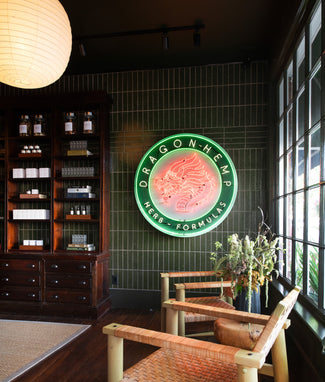
From our Rest & Restoration and Essential Wellbeing collections to our targeted Aches & Pains topicals, every product is formulated with organically grown botanicals and premium hemp extracts. We invite you to experience our sophisticated fusion of tradition and innovation at our flagship apothecary at 108 Main Street, Sag Harbor, or explore our full range of tinctures, gummies, and balms online.
Kevin Menard, LAc.
Kevin Menard, LAc., is the founder of Dragon Hemp and a licensed acupuncturist specializing in Sports Medicine Acupuncture and Traditional Chinese Medicine. He practices at his Sag Harbor clinic, where Dragon Hemp's formulas were developed.


