


Dit Da Jow — The Ancient Martial Arts Formula Behind Modern Pain Relief
|
|
Time to read 12 min
Buy 3, Get 2 Free | 40% OFF $200+
50% OFF $400+ | Shop Now
|
|
Time to read 12 min
The Short Answer: Dit Da Jow (跌打酒) — literally "fall strike wine" — is a category of traditional Chinese topical herbal formulas developed within martial arts traditions to treat traumatic injury, break up Blood stagnation, and restore channel circulation at the site of physical damage. These formulas have been refined through over 1,000 years of intensive clinical use in environments where practitioners treated high volumes of traumatic injury and tracked outcomes across generations. The result is a body of empirical knowledge about channel-penetrating herbs — Frankincense, Myrrh, Corydalis, Aconite, Camphor — that Western topical pharmacology is only beginning to approach. The Dragon Hemp Warming and Cooling Balms descend directly from this tradition.
Table of Contents
Before pharmaceutical pain management existed, there was dit da jow. Before clinical trials and double-blind studies, there were generations of martial arts practitioners treating broken bones, torn ligaments, contused muscles, and damaged joints — tracking what worked and refining what didn't across centuries of intensive observation.
Dit da jow is the product of that refinement. Not one formula but a tradition of formulas — each lineage kept proprietary, each adapted to the specific injury patterns its practitioners encountered most often — united by a common principle: the right aromatic, warming herbs applied directly at the site of trauma penetrate the channels beneath skin and muscle, move the stagnant Blood that injury produces, and allow the body's own healing mechanisms to resume their work.
The origins of dit da jow are inseparable from the history of Chinese martial arts. Shaolin Monastery, founded in 495 CE in Henan Province, became one of the earliest centers where martial arts training and traditional medical practice were developed in tandem. Monks who trained intensively in Kung Fu required reliable trauma medicine — and developed it through the same rigorous empirical observation that characterized all of classical Chinese medicine.
The formulas spread through the martial arts world as individual lineages — each school maintaining its own formula, often kept secret from outsiders, passed down from master to student alongside the fighting techniques. The secrecy was practical: a school with superior injury recovery could train harder and longer than its competitors. The formula was a competitive advantage.
By the Tang Dynasty (618–907 CE), dit da jow formulas were sufficiently established that they appear in formal medical texts alongside the classical internal medicine traditions. The Ming Dynasty Ben Cao Gang Mu (1596 CE) systematizes many of the individual herbs used in dit da jow formulas — Frankincense, Myrrh, Corydalis, Chinese Angelica Root — providing their classical indications and combinations.
The tradition continued through the Republican era and into the 20th century, where it became integrated into formal Traditional Chinese Medicine training. Today, dit da jow formulas are produced commercially in China and available through licensed TCM practitioners globally — though the most clinically refined formulas remain within specific lineages.
The clinical logic of dit da jow rests on a TCM principle that has no direct equivalent in Western topical pharmacology: the concept of channel-penetrating herbs.
In TCM anatomy, the channels (meridians) are pathways through which Qi and Blood circulate — not identical to blood vessels or nerves, but mapped through centuries of clinical observation onto functional pathways that correspond to predictable symptom patterns. When injury occurs, Blood stagnates in the affected area, blocking channel circulation and producing the combination of pain, swelling, and impaired healing that characterizes trauma.
Standard topical analgesics address the surface symptom — reducing local pain sensation through counterirritant effects or anti-inflammatory compounds absorbed through the skin. Dit da jow formulas operate on a different model: the herbs are selected specifically for their capacity to penetrate deeply through tissue and reach the channel level beneath, moving the stagnant Blood rather than simply masking the pain it produces.
The aromatic herbs in dit da jow formulas — Camphor, Cajeput, Cloves, Aconite — serve a dual function: their volatility allows them to penetrate skin and tissue rapidly, and their warming or cooling thermal nature addresses the specific pathogenic factor (Cold, Damp, Heat) obstructing the channel. They open the pathway. The Blood-moving herbs — Frankincense, Myrrh, Corydalis, Red Peony — then act on the stagnation the pathway now reaches.
Camphor — aromatic, deeply penetrating, cooling. Opens channels, clears Heat, produces immediate sensation that confirms penetration. The classic counterirritant with genuine channel-reaching properties.
Cajeput — warming, penetrating, analgesic. Closely related to eucalyptus, with similar volatility but stronger warming action. Ideal for Cold Bi presentations.
Aconite (Fu Zi) — the most powerful warming herb in the TCM pharmacopeia. Dispels deep Cold from the channels. Used in warming formulas for Cold Bi — severe, fixed pain that improves dramatically with heat application. Raw Aconite is toxic and never used internally without processing; in its processed form for external topical application, it has been used safely in dit da jow formulas for centuries and is the appropriate preparation for the Warming Balm's intended use.
Cloves — intensely warming, penetrating. Moves Qi, warms the channels, addresses Cold and Damp obstruction.
Frankincense (Ru Xiang) — moves Qi and Blood, opens channels, promotes tissue regeneration. The primary channel-opener in classical dit da jow formulas.
Myrrh (Mo Yao) — disperses Blood stagnation, reduces swelling, promotes healing. The primary Blood-mover. Inseparable from Frankincense in trauma formulas.
Corydalis (Yan Hu Suo) — direct analgesia through THP, moves Qi and Blood. The analgesic anchor of the formula.
Red Peony Root (Chi Shao) — cools Blood, invigorates circulation without adding Heat. Used in cooling formulas for Heat Bi presentations.
The most clinically significant distinction in dit da jow formulas is the thermal nature — warming formulas for Cold and Damp Bi patterns, cooling formulas for Heat Bi and acute inflammation. Applying a warming formula to a Hot presentation intensifies the Heat. Applying a cooling formula to a Cold presentation drives the Cold deeper. The pattern must be correctly identified before the formula is selected.
This is the clinical intelligence built into the Dragon Hemp Warming and Cooling Balms. They are not two versions of the same product. They are two formulas for two distinct Bi patterns:
The Warming Balm — with Aconite, Capsicum, Cajeput, Cloves, and Mugwort — is specifically formulated for Cold and Damp Bi: the fixed, severe pain that worsens in cold environments, the joint stiffness that improves dramatically with heat, the chronic aching that accumulates in cold and damp weather. The warming herbs dispel the pathogenic Cold and Damp from the channels. The Blood-moving herbs address the stagnation they have caused.
The Cooling Balm — with Camphor, Gardenia Fruit, Red Peony Root, and Cajeput — is formulated for Heat Bi and acute inflammatory presentations: hot, swollen, red joints; the burning pain of excess Heat in the channels; the post-exertion inflammation that feels worse with heat and better with cold. The cooling herbs clear the Heat pathogen. Frankincense and Myrrh move the stagnation the Heat has generated.
Read more about bi syndrome in TCM.
Formulated to warm the body and move stagnation in joints and muscles that have grown stiff over time.
This fast-acting topical moves with you, pairing a robust concentration of full-spectrum hemp extract with heating Chinese herbs to provide a deep, circulating warmth to areas of lingering discomfort.
Drawing from time-honored ‘dit da jow’ martial arts formulas, this high-potency blend encourages blood flow and thaws the "stuck" energy that makes movement feel like a chore to help you reclaim your daily mobility and stay active with ease.
Because chronic stiffness shouldn’t be a barrier—and finding your flow should feel effortless.
Formulated to calm the body and clear excess heat following activity or physical stress.
This fast-acting topical moves with you, pairing a robust concentration of full-spectrum hemp extract with cooling Chinese herbs to provide a steady, refreshing chill to areas of sudden sensitivity.
Drawing from time-honored ‘dit da jow’ martial arts formulas, this high-potency blend encourages circulation while systematically diffusing the "trapped" heat from overexertion to help you maintain balance and return to movement.
Because recovery shouldn’t be a waiting game—and keeping your cool shouldn’t keep you frozen in place.
The Dragon Hemp Warming and Cooling Balms add one element that classical dit da jow formulas did not have: 3,600mg of full-spectrum hemp extract per formulation. CBD and the minor cannabinoids in full-spectrum hemp engage CB2 receptors expressed in skin, joint tissue, and immune cells — producing local anti-inflammatory modulation at the exact site where the TCM herbs are also working.
This is not a substitute for the TCM formula. It is an addition that addresses the ECS dimension of local inflammation — the dimension that classical herbalism, developed before the endocannabinoid system was discovered, could not account for. The combination addresses the channel obstruction pattern through the classical TCM mechanism and the local inflammatory cascade through the ECS mechanism simultaneously.
Direct Answer: Dit Da Jow (跌打酒) is a category of traditional Chinese topical herbal formulas — literally "fall strike wine" — developed within martial arts traditions over 1,000 years to treat traumatic injury, break up Blood stagnation, and restore channel circulation at the site of physical damage.
Clinical Context: Dit da jow formulas were refined through intensive clinical observation in martial arts environments where practitioners treated high volumes of traumatic injury. The result is a body of empirical knowledge about channel-penetrating herbs that modern Western topical pharmacology has not yet replicated — herbs selected specifically for their capacity to penetrate deeply through tissue and reach the channel level beneath.
Direct Answer: Classical dit da jow formulas vary by lineage but typically contain: Frankincense (Ru Xiang), Myrrh (Mo Yao), Corydalis (Yan Hu Suo), Chinese Angelica Root (Dang Gui), and aromatic penetrating herbs such as Camphor, Cajeput, or Aconite — varied based on whether the formula is warming or cooling in thermal nature.
Clinical Context: The Dragon Hemp Warming Balm contains Aconite, Cajeput, Capsicum, Cloves, Corydalis, Frankincense, Licorice Root, Mugwort, Myrrh, and Pubescent Angelica Root — a warming formula for Cold and Damp Bi. The Cooling Balm contains Cajeput, Camphor, Corydalis, Frankincense, Gardenia Fruit, Licorice Root, Myrrh, and Red Peony Root — a cooling formula for Heat Bi and acute inflammation.
Direct Answer: The individual herbs in dit da jow formulas — Frankincense (boswellic acids / 5-LOX inhibition), Corydalis (THP / dopamine and opioid receptor modulation), and Turmeric/curcumin (COX-2 inhibition) — have confirmed pharmacological mechanisms supporting their anti-inflammatory and analgesic properties. The combination and topical delivery have been validated through 1,000 years of clinical use.
Clinical Context: Formal double-blind RCTs on complete dit da jow formulas are limited — research has focused on individual compounds. The clinical evidence for the individual active compounds (THP, boswellic acids, curcumin) is substantial. The 1,000-year refinement of the formulas represents a form of empirical validation that modern trial design has not yet replicated at scale.
Direct Answer: Dit da jow is used primarily for: traumatic injury (bruising, contusions, sprains), chronic joint pain and stiffness, post-exertion muscle soreness, Bi Syndrome (Cold, Damp, or Heat obstruction of the channels), and any musculoskeletal condition characterized by Blood stagnation at the site of pain.
Clinical Context: The correct formula type depends on the pattern: warming formulas for Cold Bi (pain worse in cold, improves with heat), cooling formulas for Heat Bi (hot, inflamed joints, acute injury with significant inflammation). Applying the wrong thermal type to a pattern can temporarily worsen symptoms.
Direct Answer: Apply topically to the affected area, massaging in until absorbed. Use the warming formula for Cold Bi and chronic stiffness; the cooling formula for acute inflammation, hot joints, and post-exertion heat. Can be applied multiple times daily. Avoid broken skin.
Clinical Context: Classical application involved vigorous rubbing to generate heat and drive the herbs deeper into the tissue — a technique that mirrors the modern understanding of how massage increases topical absorption. The Dragon Hemp Warming and Cooling Balms are designed for this application method, with carrier compounds selected to enhance penetration.
Direct Answer: The core herbs in classical dit da jow formulas are Frankincense (Ru Xiang), Myrrh (Mo Yao), Corydalis (Yan Hu Suo), Chinese Angelica Root (Dang Gui), and aromatic penetrating carriers such as Camphor, Cajeput, Aconite, or Cloves — varied based on whether the formula is warming or cooling in thermal nature.
Clinical Context: Each herb serves a distinct function in the formula. Frankincense moves Qi and opens channels — it is the primary channel-opener, creating the pathway through which the other herbs act. Myrrh disperses Blood stagnation at the tissue level — the accumulation that perpetuates chronic pain after the initial injury or obstruction. Corydalis provides direct analgesia through tetrahydropalmatine (THP), acting on dopamine and opioid receptors simultaneously. Chinese Angelica Root nourishes Blood to prevent the moving herbs from depleting it over extended use. The aromatic carriers — Camphor, Cajeput, Aconite, Cloves — are selected for their ability to penetrate deeply through skin and tissue and reach the channel level beneath, where the Blood-moving herbs then work. The 3,600mg full-spectrum hemp extract in the Dragon Hemp Warming and Cooling Balms adds CB2 receptor engagement at the same site, covering the ECS-mediated inflammatory dimension that classical dit da jow formulas predate.
Direct Answer: The single most reliable indicator is temperature response. If your pain improves with heat and worsens with cold or damp conditions, use a warming formula. If your pain improves with cold and the area feels hot, swollen, or red, use a cooling formula. For acute injuries within 48 hours, always start with cooling regardless of your usual pattern — fresh trauma always presents with Heat initially.
Clinical Context: In TCM, this distinction maps to the Bi Syndrome pattern type. Warming dit da jow formulas — like the Dragon Hemp Warming Balm, with Aconite, Capsicum, and Cloves — are formulated for Cold Bi and Damp Bi: chronic, fixed, aching pain that worsens in cold or damp weather and loosens with movement and heat. Cooling formulas — like the Dragon Hemp Cooling Balm, with Camphor, Gardenia Fruit, and Red Peony Root — are formulated for Heat Bi: hot, inflamed, throbbing pain that worsens after activity and improves with cold application. Applying the wrong thermal formula to the wrong pattern is the most common clinical error with dit da jow — a warming formula applied to an actively inflamed joint will temporarily intensify the Heat. When the pattern is unclear, cooling is the safer default.
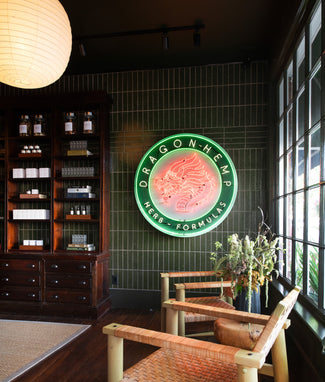
Dragon Hemp was established by Kevin Menard, LAc, a specialist in Sports Medicine Acupuncture and Traditional Chinese Medicine. Developed in his Sag Harbor clinic, our formulations bridge the gap between ancient herbal wisdom and modern cannabinoid research to address the root causes of pain, sleep, and wellness issues.
From our Rest & Restoration and Essential Wellbeing collections to our targeted Aches & Pains topicals, every product is formulated with organically grown botanicals and premium hemp extracts. We invite you to experience our sophisticated fusion of tradition and innovation at our flagship apothecary at 108 Main Street, Sag Harbor, or explore our full range of tinctures, gummies, and balms online.


