



Liver Qi Stagnation: The TCM Root of Anxiety
|
|
Time to read 13 min
Buy 2, Get 1 Free | 40% OFF $250+
50% OFF $500+ | Shop Now
|
|
Time to read 13 min
Liver Qi Stagnation is the TCM name for stuck emotional energy. When the Liver's job of moving Qi smoothly stalls, tension, irritability, and anxiety build.
The Liver governs the free flow of Qi. In TCM it regulates the smooth movement of both blood and emotion; frustration is its signature strain.
Its signs are specific and recognizable. A tight chest, frequent sighing, irritability, a lump-in-the-throat feeling, PMS, and tension that migrates around the body.
Modern stress maps onto the pattern. Chronic stress dysregulates the nervous system and the HPA axis — the physiological echo of Qi that has stopped moving.
The endocannabinoid system helps regulate the stress response. CBD supports the ECS tone the body relies on to return to baseline after activation.
Calming Gummies support the always-on nervous system. Calming Gummies are formulated for the overworked mind that carries more than it should.
Table of Contents
The Short Answer: Liver Qi Stagnation (肝气郁结) is the Traditional Chinese Medicine pattern behind much of what modern life calls anxiety — a tight chest, irritability, frequent sighing, and a sense of pressure without a clear cause. In TCM, the Liver governs the free flow of Qi; when stress, frustration, or overwork obstruct that flow, Qi stagnates and the body registers it as tension and unease. The remedy is not suppression but movement — restoring flow through acupuncture, breath, gentle exercise, and consistent daily support for a nervous system that has forgotten how to return to baseline.
You know the feeling before you have a name for it. The chest that will not fully open. The breath that keeps arriving as a sigh. The irritability that flares at something small because it is standing in for something large. The sense of pressure — behind the sternum, at the base of the throat, across the shoulders — that no test explains and no single cause accounts for. Modern life calls this anxiety and reaches for a way to quiet it. Traditional Chinese medicine calls it something more specific, and reaches instead for a way to move it.
The name is Liver Qi Stagnation. It is one of the most common patterns I see in clinic — and while it is not the only root of anxiety in TCM, it is the one most tied to the pressures of modern life, and most often the pattern beneath the symptom.
In TCM, the Liver is not primarily the metabolic organ of Western medicine. It is the organ of movement — specifically, the smooth, unobstructed movement of Qi throughout the body. The classical phrase is that the Liver "governs the free flow." When that flow is smooth, emotion moves through you and passes. Frustration arrives, is felt, and clears. Plans form and translate into action. The body's energy circulates the way a river runs when nothing dams it.
Qi is simply the body's animating movement — the flow of function and vitality that keeps everything in motion. Stagnation is what happens when that flow meets an obstruction and stops. And the thing that most reliably obstructs the Liver is unexpressed or unrelenting emotional pressure: frustration held rather than moved, stress absorbed rather than discharged, the low-grade friction of a life run at a pace the nervous system was never designed to sustain. The Liver is the organ most sensitive to that friction. It is the first to stagnate, and when it does, the free flow becomes a held breath.
The pattern is recognizable because its signs cluster in a way patients describe almost identically. A tightness or distension in the chest and ribs — the Liver channel runs through this region, and stagnation registers here first. Frequent sighing, which is the body's instinctive attempt to move stuck Qi and release the chest. Irritability and a short fuse, the emotional signature of Wood energy under pressure. A lump-in-the-throat sensation with nothing physically there — classical TCM calls this "plum-pit qi," and it is Liver Qi Stagnation until proven otherwise.
There is often a physical restlessness, tension that migrates — a headache one day, a knotted shoulder the next, digestive unease after that. When the Liver stagnates it tends to "overact" on the digestive system, producing the bloating and appetite changes that so often travel with stress. In the menstrual cycle it shows up as premenstrual irritability, breast tenderness, and cramping. And it disturbs sleep in a characteristic way: falling asleep is possible, but the mind wakes in the small hours — often between one and three in the morning, the window the Chinese organ clock assigns to the Liver — and will not settle.
None of these is random. They are the same pattern expressing itself through different tissues. The unifying experience is pressure without a clear cause — the felt sense of energy that wants to move and cannot.
Left unmoved, stagnant Qi does not stay quiet. In TCM, obstruction over time generates Heat — the way a blocked river grows turbulent behind the dam. That Heat rises, and as it rises it disturbs the Shen, the mind-spirit housed by the Heart. This is the TCM mechanism of anxiety: not a disorder arriving from nowhere, but stagnation maturing into internal Heat that unsettles the mind. The racing thoughts, the restlessness, the sense of being wired and unable to land — these are the Shen disturbed by Heat that began as Qi that stopped moving. It is worth saying plainly that not all anxiety is Liver Qi Stagnation — TCM also recognizes patterns rooted in Heart Blood and Yin deficiency, in the Kidneys, and in a constitutionally timid Gallbladder. The disturbed Shen does not always look the same. When it sharpens specifically around social and performance situations — the dread that arrives before the room does — it takes the recognizable form we address in our guide to CBD for social anxiety. And when stagnation persists long enough to deplete rather than agitate, so the pressure flattens into low mood rather than restlessness, it shades toward the pattern we explore in our guide to CBD, serotonin, and depression. But stagnation is the pattern I see most, and the one modern life most reliably produces.
The modern nervous system tells the same story in different language. Chronic stress holds the body in sympathetic dominance — the activated, "on" state — and over time dysregulates the hypothalamic-pituitary-adrenal axis, the system that governs how the body mounts and, crucially, recovers from stress. The hormone at the center of that loop is cortisol, and when it stops falling the way it should, the wired-but-tired state sets in — a mechanism we unpack in our deep dive on CBD and cortisol. A regulated nervous system activates and then returns to baseline. A dysregulated one activates and stays there. That failure to return — to stand down, to let the breath drop, to let the chest open — is what stagnation feels like from the inside. It is also why the acupuncture that TCM has used for this pattern for centuries has drawn modern research attention: clinical reviews of acupuncture for anxiety continue to examine its role in downregulating that activated state.
There is a regulatory system that sits close to the center of this picture: the endocannabinoid system (ECS). Among its roles is helping modulate the stress response and the return to baseline after activation — the very recovery that Liver Qi Stagnation, and its modern counterpart of chronic sympathetic load, interferes with. That sustained load is not only a feeling; it registers in the body, from persistent tension to a heightened cardiovascular stress response — one thread we follow in our review of CBD and blood pressure research. When the ECS has the tone it needs, the body is better equipped to move through activation and settle. Emerging research on cannabidiol and anxiety examines how CBD interacts with this system and with the circuits that govern the stress response.
This is where a practitioner's approach becomes practical rather than theoretical. Liver Qi Stagnation is not resolved by forcing calm on top of pressure. It is resolved by restoring flow — and the daily foundation that supports a dysregulated nervous system is part of restoring that flow.
In clinic I think of the daily support for this pattern as a Free Flow protocol — a small, consistent stack aimed at helping a chronically activated nervous system move and settle rather than stay stuck.
Begin with the foundation. The Wellness Tincture is the daily ECS support that a chronically activated nervous system benefits from most — 60mg full-spectrum CBD supporting the endocannabinoid tone the body relies on to regulate its stress response. Consistency is the point. The ECS responds to steady daily input, not to a single dose reached for in a hard moment.
Formulated to fortify your baseline and invite a sense of steady composure—day in and day out.
This Certified Organic formula features pure, full-spectrum CBD—selected to support a healthy inflammatory response and daily immune function. This pure, restorative ritual works systemically to build a resilient shield against the physical and mental wear of modern life, ensuring you remain adaptable regardless of what the day demands.
Because true balance is cumulative—and a strong foundation makes every day effortless.
For the mind that runs hot through the day — the always-on brain that carries more than it should and cannot seem to set it down — the Calming Gummies are formulated as an anytime wind-down for exactly this load. They are designed for the person whose nervous system has forgotten how to downshift, and who needs support returning to a settled baseline rather than being sedated out of one.
Formulated to ground the nervous system and invite a gentle return to center—without dulling your senses.
This precise dose of Full-Spectrum CBD—selected to help buffer the overstimulation of modern life and quiet the mental noise of a demanding day—supports a resilient reset whenever you need it most. This clean, plant-based approach helps you navigate life's sharpest stressors with a sense of composed clarity.
Because a moment of pause shouldn’t be a luxury—and finding your balance should be effortless.
And for the characteristic sleep disruption of this pattern — the one-to-three a.m. waking, the mind that will not settle in the Liver's own hours — the Sleep Tincture is closely matched to the mechanism. Its Suan Zao Ren Tang base nourishes Liver Blood and calms the Heart-Shen: the classical formula for a mind kept awake by the very Heat that Liver Qi Stagnation generates. Those who want the full clinical breakdown can read our companion article on the Suan Zao Ren Tang formula.
Practitioner-formulated to restore the balance necessary for a full, deep sleep cycle.
This high-potency tincture draws from time-honored 'Suan Zao Ren Tang' formulas, blending traditional Chinese herbs—long-trusted to settle a restless mind and nourish the spirit—with nano-encapsulated CBD & CBN to target the racing thoughts and midnight wakefulness that disrupt your rest. By helping you stay asleep longer, it ensures your body reaches the deep cycles essential for systemic recovery and physical restoration.
Because a full night of sleep is about more than just rest—it’s about waking with the energy and focus to feel like yourself again.
None of this replaces the deeper work, and I would be a poor practitioner to suggest it did. Liver Qi Stagnation ultimately asks for movement in the literal sense — exercise that discharges what accumulates, breath that reopens the chest, expression that lets held emotion actually move, and the acupuncture that has addressed this pattern for as long as the pattern has had a name. The daily rituals support that work. They do not substitute for it.
Here is what I tell patients who arrive with the tight chest and the sighing and the sense that something is pressing they cannot name. The pressure is not a flaw in you. It is Qi that wants to move and has not been given the room. Your work is not to silence the signal. It is to open the channel — a little movement, a little breath, a little consistency, day after day, until the river runs again. The people who do that do not spend their lives managing the same held breath. They let it go. — Kevin Menard, LAc.
Direct Answer: Liver Qi Stagnation (肝气郁结) is a TCM pattern in which the Liver's job of moving Qi smoothly through the body becomes obstructed, most often by chronic stress or unexpressed emotion. It is the pattern most closely associated with tension, irritability, and anxiety.
Clinical Context: In TCM the Liver governs the "free flow" of Qi and emotion. When that flow stalls, energy that should move and pass instead accumulates, producing a felt sense of pressure. Practitioners treat it as a root pattern — the underlying obstruction beneath many stress-related complaints — rather than as a collection of separate symptoms.
Direct Answer: Common signs include a tight or distended chest, frequent sighing, irritability, a lump-in-the-throat sensation ("plum-pit qi"), premenstrual tension, digestive upset under stress, migrating tension, and waking between 1 and 3 a.m.
Clinical Context: These signs cluster because they are one pattern expressed through different tissues. The Liver channel runs through the chest and flanks, so tension registers there first; the Liver's tendency to "overact" on digestion explains the stress-related bloating; and the 1–3 a.m. waking corresponds to the Liver's window on the Chinese organ clock. The unifying experience is pressure without a clear cause.
Direct Answer: The most common cause is chronic emotional pressure — frustration, stress, or overwork that is absorbed rather than discharged. Irregular schedules, insufficient movement, and a pace of life that keeps the nervous system activated all contribute.
Clinical Context: The Liver is the organ most sensitive to emotional friction, which is why it is typically the first to stagnate. In modern terms, a life that holds the body in a sustained "on" state — without the movement, rest, and expression that let activation discharge — is the lifestyle that most reliably produces the pattern.
Direct Answer: In TCM, stagnant Qi generates Heat over time, and that Heat rises to disturb the Shen (mind-spirit), producing the restlessness and racing thoughts of anxiety. It is anxiety understood as a downstream consequence of obstructed flow.
Clinical Context: The modern parallel is a nervous system held in sympathetic dominance, with a dysregulated HPA axis that activates but struggles to return to baseline. Both frameworks describe the same lived experience — energy that will not settle — and both point toward restoring the body's capacity to stand down rather than simply suppressing the symptom. It is worth noting that Liver Qi Stagnation is the most common TCM pattern behind anxiety, not the only one — a practitioner distinguishes it from deficiency-based patterns before choosing an approach.
Direct Answer: The guiding principle is to restore movement: regular exercise, breathwork that reopens the chest, emotional expression, acupuncture, gentle Liver-supporting foods, and consistent daily rituals that help a chronically activated nervous system settle.
Clinical Context: Because the pattern is one of obstruction, the remedy is flow rather than force. Acupuncture has been used for this pattern for centuries; movement discharges what accumulates; and steady daily support for the nervous system and endocannabinoid system helps the body relearn its return to baseline. Suppressing the signal without moving the underlying stagnation tends to postpone it, not resolve it.
Direct Answer: CBD is not a treatment for Liver Qi Stagnation or for anxiety, and it is not a cure. It is daily wellness support: research examines how CBD interacts with the endocannabinoid system's role in regulating the stress response, which is one part of a broader approach.
Clinical Context: In a TCM frame, CBD is one tool among many for a nervous system under chronic load — most useful as consistent daily support alongside the movement, acupuncture, and lifestyle adjustments that address the stagnation at its root. The endocannabinoid system helps modulate the return to baseline after stress, and supporting its tone is a reasonable part of a whole-person protocol, not a standalone fix.
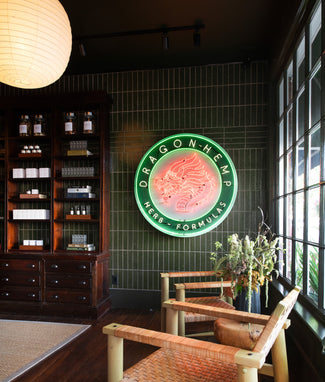
Dragon Hemp was established by Kevin Menard, LAc, a specialist in Sports Medicine Acupuncture and Traditional Chinese Medicine. Developed in his Sag Harbor clinic, our formulations bridge the gap between ancient herbal wisdom and modern cannabinoid research to address the root causes of pain, sleep, and wellness issues.
From our Rest & Restoration and Essential Wellbeing collections to our targeted Aches & Pains topicals, every product is formulated with organically grown botanicals and premium hemp extracts. We invite you to experience our sophisticated fusion of tradition and innovation at our flagship apothecary at 108 Main Street, Sag Harbor, or explore our full range of tinctures, gummies, and balms online.
Kevin Menard, LAc.
Kevin Menard, LAc., is the founder of Dragon Hemp and a licensed acupuncturist specializing in Sports Medicine Acupuncture and Traditional Chinese Medicine. He practices at his Sag Harbor clinic, where Dragon Hemp’s formulas are developed alongside his clinical work. His protocols integrate classical Chinese herbal medicine with modern cannabinoid research.


