





Hemp in the Crossfire: Politics, Progress, and the Fight for Plant-Based Wellness
|
|
Time to read 14 min
FREE SHIPPING ON ORDERS OVER $50 SHOP NOW
|
|
Time to read 14 min
It’s not every day that cannabis reform sparks a full-blown rebellion within the Republican Party—but that’s exactly what’s happening right now.
In December, President Trump made headlines by announcing his intent to reduce government restrictions on marijuana. Specifically, he urged federal agencies to reclassify cannabis from Schedule I (the same category as heroin) to Schedule III, which would acknowledge its medical value and ease the burden on researchers, patients, and small businesses alike.
Standing beside him? Health Secretary Robert F. Kennedy Jr., a longtime advocate for medical cannabis who emphasized its “miraculous effects” on conditions like chronic pain, PTSD, and epilepsy.
Trump didn’t just stop at marijuana. He also called on Congress to revisit and revise the statutory definition of hemp-derived products—a bold rebuttal to the quietly passed November spending bill that threatens to devastate the entire hemp wellness industry.
Table of Contents
In case you missed it:
Congress passed a spending bill that would reclassify nearly all hemp-derived products as Schedule I narcotics—the strictest classification under federal law. If unchanged, this would:
Wipe out up to 95% of hemp wellness products currently on the market
Shut down thousands of small businesses and family farms
Cut off access to effective, plant-based care for millions of people
This provision—tucked quietly into the end-of-year government funding package—is scheduled to take effect in November 2026.
At Dragon Hemp, we see this not just as a regulatory misstep, but a direct threat to health freedom. The ability to choose plant-based, practitioner-formulated care shouldn’t be political—it should be personal.
The Republican backlash to Trump’s announcement was swift and loud.
Twenty-two GOP Senators and more than two dozen House Republicans sent open letters condemning his decision to ease cannabis rules, claiming it would “send the wrong message to children” and “make our roads more dangerous.” Speaker Mike Johnson even lobbied Trump directly to reverse course.
But Trump stood firm.
“We have people begging me to do this,” he said. And he’s right—public support for medical cannabis consistently polls over 80% nationwide.
Perhaps even more telling, Trump’s actions align him with Senator Rand Paul, one of the few Republicans openly opposing the hemp ban. Paul has warned that the new restrictions would “make 95 to 98 percent of legal hemp products illegal”, gutting an industry that supports farmers, manufacturers, and everyday consumers.
It’s rare that a sitting president defies his party on an issue like this. It’s even rarer when he does so in the name of accessibility.
Trump’s announcement and Kennedy’s backing are significant. So is the introduction of the Cannabinoid Safety and Regulation Act, led by Oregon Senators Ron Wyden and Jeff Merkley. This bill proposes a science-based framework to regulate—not ban—hemp-derived products, offering a path forward rooted in oversight, not fear.
These are important developments. But they don’t undo the ban.
And the November reclassification of hemp-derived cannabinoids as Schedule I drugs remains on the books.
Which means we still need Congress to act. Quickly.
This isn’t just about saving a product category. It’s about protecting your right to choose safe, plant-based care. It’s about defending an industry that provides relief, not just remedies.
We’ve made it easy to raise your voice:
👉 Click here to send a pre-written letter to your representatives.
All you have to do is enter your name and zip code. That’s it. Less than a minute of your time.
By taking action, you’re helping protect:
Access to effective hemp-derived therapeutics
The future of small businesses and farms across the country
Your ability to choose the care that works best for your body
At Dragon Hemp, we’re not passive observers. We’re participants in this moment.
We’re here to advocate for our customers, our industry, and the deeper philosophy that underpins our work: that wellness is a journey. And that journey should never be limited by outdated policy or political infighting.
So let’s move forward together.
Let’s push for a future where plant-based care is not criminalized but celebrated for its power to heal.
Take action. Stay informed.
And thank you for standing with us—we’ll keep you updated every step of the way.
Independent analysts and reporting from CNN, Forbes, and Newsweek paint a clear picture:
The hemp ban would shut down most of the hemp-derived wellness market — with an estimated 95% of products affected.
The consequences include:
A $28–30 billion sector at risk.
Retail sales across hemp-derived gummies, tinctures, beverages, vapes, and topicals represent a multibillion-dollar market. Under the hemp ban, most of these products would no longer be legal.
More than 300,000 jobs impacted.
Farmers, extractors, manufacturers, logistics networks, distribution partners, retailers, hospitality businesses, and wellness brands — including small businesses like Dragon Hemp — all stand in the path of disruption by the hemp ban.
Severe impact on state economies.
States with significant hemp infrastructure — including Kentucky, Texas, Utah, Oregon, and Colorado — could lose more than $1.5 billion in annual tax revenue under the hemp ban, according to industry estimates.
The rise of unregulated markets.
Experts across multiple outlets warn that banning regulated hemp products will not eliminate demand. Instead, the hemp ban pushes consumers toward untested products sold without age restrictions or quality standards.
As one executive told CNN: “Bad actors thrive when things disappear from the formal economy.”
A wave of small-business closures nationwide.
Forbes described the hemp ban as “an extinction-level event” for many hemp companies — especially brands without large investors, national distribution, or diversified operations. Small businesses like Dragon Hemp, which rely on regulated full-spectrum formulas and farm partnerships, would be among the most vulnerable to the hemp ban.
Nothing changes about your access — for now. Even thought the hemp ban has been signed, hemp-derived products remain available during the 365-day grace period. But without policy revisions or new legislation, many of the tools people rely on every day could disappear under the hemp ban — including full-spectrum tinctures, functional gummies, hemp-derived beverages, gentle sleep and stress formulations, and topicals made with naturally occurring cannabinoids.
And it’s not just people who use THC for relaxation or as an alcohol alternative who would be affected. This amendment also targets the trace, non-intoxicating amounts of THC that naturally occur in full-spectrum CBD and other hemp extracts — the very compounds that help these products support sleep, ease stress, calm the nervous system, and reduce discomfort. These tiny amounts aren’t what get people “high”; they’re what make full-spectrum formulas work.
For millions of people, these aren’t luxuries. They’re part of a daily routine that helps support restful nights, steady moods, and manageable pain levels without turning to harsher pharmaceuticals or intoxicating substances. The new amendment removes that access without offering a regulatory framework to protect safety, quality, or consistency, leaving a lot of uncertainty in its place.
And there’s another reality we need to acknowledge: if the hemp ban stands, Dragon Hemp may no longer be able to operate as a company. Nearly all of our formulas would be classified as illegal under the new definition. That would mean you’d lose access not just to products you love, but to the plant-based support you count on to feel like yourself again.
Dragon Hemp is the practitioner-founded apothecary that produces plant-based therapeutics formulated with a proprietary blend of next-generation botanicals and time honored herbal remedies.
For people seeking treatments that give relief & address the root cause.
Our herbal remedies are innovative and user-friendly, with wellness benefits that are effective & accessible to everyone.
So you can feel like yourself again.
Kevin Menard, LAc., is the leading practitioner in Sports Medicine Acupuncture and Traditional Chinese Medicine on the East End of Long Island, with clientele ranging from business executives and fitness professionals to wellness gurus and weekend warriors.
As he cultivated his practice, Kevin began integrating CBD & other cannabinoids, native botanicals, and herbs into his treatments, addressing conditions like pain, musculoskeletal injuries, insomnia, overall wellness, and so much more.
Following the promising results from his herbal and CBD-infused treatments, Kevin expanded his work, introducing Dragon Hemp to support patient wellness beyond his clinic's walls.
Our Apothecary in Sag Harbor, New York was conceived as a beacon of rejuvenation and wellness in the Hamptons. Much more than a dispensary, at the core of the Dragon Hemp Apothecary is a commitment to education and understanding the benefits of time-honored herbal remedies synthesized with today’s advancements in cannabinoid research.
Offering an array of products designed to align with the wellness needs of the Hamptons community, the store seeks to bridge the gap between ancient wisdom and modern applications, making herbal medicine more compatible with our lifestyles today. Our unique apothecary in Sag Harbor not only represents a physical space but also embodies Dragon Hemp's ethos of premium, all-natural, effective wellness solutions, drawing from the rich heritage of the Hamptons and the innovative spirit of New York.
Not your conventional dispensary, our first-of-its-kind retail location, harmoniously balances tradition and innovation with an emphasis on experience and education. We invite you to step inside and let our herbal experts guide you on an exploration of the rejuvenating power of cannabinoids and traditional herbs in a setting that feels both timeless and contemporary.
Designed in collaboration with renowned Alfredo Paredes Studio, the apothecary embodies a sophisticated fusion of old-world tradition and contemporary application. Known for his 33-year tenure as Ralph Lauren Executive Vice President and Chief Creative Officer, Alfredo Paredes, a master of crafting memorable retail experiences, helped transform the space into a shining gem of Sag Harbor. Reflecting the premium, natural, and therapeutic essence of Dragon Hemp, every aspect of the store, including the unique furniture pieces from Paredes' line, contributes to an ambiance of refined tranquility and wellness. The design echoes a classic herbal pharmacy blended with a modern aesthetic, mirroring our brand ethos of contemporizing ancient herbal medicine for today’s applications. Read more about our Apothecary design in Forbes.
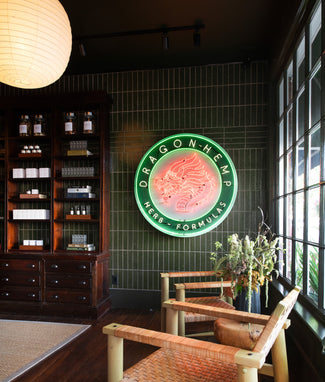
Standing out on Main Street in Sag Harbor with the glow of our distinctive neon sign, our unique retail store has become a design destination of its own -- beyond just wellness -- in one of the Hamptons’ most popular villages. Whether you’re looking for potent natural therapeutics to tackle pain & inflammation or legal THC products to enhance mood or improve sleep, our apothecary is your safe haven at 108 Main Street.
Our products are formulated to serve the four crucial daily needs most often seen in Kevin’s practice—Essential Wellbeing for comprehensive health, Rest & Restoration to foster rejuvenation, Aches & Pains for relief from discomfort, and Liniments for body care that enhances both physical and emotional wellbeing.
Available in four versatile forms—swift-absorbing tinctures, targeted balms, discreet gummies, and moisturizers—we ensure a suitable choice for every lifestyle and wellness routine.
We carefully select our organically grown ingredients, emphasizing sustainability to protect Earth's biodiversity.
We believe in transparency in all our processes, from ingredient selection to the methods used by our CBD farmers, who lead the sustainable agriculture charge and concentrate on ecosystem restoration and carbon sequestration.
We're not just about products but about nurturing an understanding of traditional herbal practices and helping people make healthy decisions.
With respect, we introduce newcomers to the benefits of age old herbal wisdom.
Our aim is a future where well-being stems from nature, combining timeless knowledge with today's research.
Discover the distinctive characteristics of each herb in our Ingredient Index.
Hemp is not banned entirely, but the new federal hemp ban drastically restricts how much THC can appear in any hemp product. The government cited concerns about intoxicating hemp-derived cannabinoids like delta-8 and delta-10. Critics argue the hemp ban overcorrects by eliminating products that contain only trace, non-intoxicating THC found naturally in full-spectrum CBD.
The new law — commonly called the 2025 hemp ban — limits all hemp products to 0.4 mg total THC per container, a level so low that more than 95% of products would be illegal. The hemp ban treats all forms of THC equally, including naturally occurring trace amounts that provide therapeutic benefits in full-spectrum formulas.
Yes. The hemp ban affects any dispensary that carries hemp-derived ingestibles, tinctures, gummies, vapes, or topicals with more than 0.4 mg total THC per package. Cannabis dispensaries selling regulated marijuana products are still allowed to operate, but hemp-derived items in their inventory would be impacted by the hemp ban.
Under the hemp ban, nearly all full-spectrum and broad-spectrum hemp products become illegal, including:
tinctures containing trace THC
hemp-derived gummies
hemp beverages
vapes
most topicals
Only products with less than 0.4 mg THC per container remain compliant — meaning almost everything currently on shelves violates the hemp ban.
Most CBD oils containing full-spectrum or broad-spectrum extracts would be banned under the hemp ban. You can still buy hemp for now during the 365-day grace period, but the hemp ban will outlaw most forms of CBD oil after that window unless the law is revised.
Delta-9 THC below 0.3% by dry weight remains federally illegal, but the new hemp ban goes much further by restricting total THC to 0.4 mg per package in any hemp product. THC itself was not newly banned; rather, hemp-derived products containing THC were effectively removed from the market through the hemp ban.
Yes — THCA falls under “total THC” in the hemp ban. Because THCA converts into delta-9 THC when heated, the hemp ban counts it toward the 0.4 mg limit. This means nearly all THCA products would be illegal once the hemp ban takes effect.
No. Hemp is not harmful to humans, and decades of research show hemp-derived cannabinoids are generally well tolerated. The hemp ban is not based on toxicity or safety concerns, but rather on attempts to regulate intoxicating hemp derivatives — though the hemp ban unintentionally eliminates non-intoxicating and therapeutic products as well.
The 2018 Farm Bill legalized hemp nationwide and defined it as cannabis with less than 0.3% delta-9 THC. A perceived “loophole” allowed companies to extract and concentrate other hemp-derived cannabinoids, which eventually led lawmakers to push for the hemp ban.
The 2025 Farm Bill has not been passed. Instead, the hemp ban was inserted into the government funding bill that ended the shutdown. The 2018 Farm Bill technically remains in place, but the hemp ban overrides its THC framework.
Yes, the hemp ban passed. It includes a 365-day grace period from the moment the President signed it. Once the grace period ends, the hemp ban becomes fully enforceable nationwide unless Congress amends or replaces it.
No, hemp itself is not illegal — but the hemp ban will make nearly all hemp-derived wellness products illegal due to the extreme 0.4 mg THC limit.
States are banning hemp because the new federal hemp ban has created confusion, pressure, and urgency around how states regulate hemp-derived products. Many state lawmakers see the federal hemp ban as a signal to tighten their own rules, especially around intoxicating cannabinoids like delta-8 and delta-10.
Some states are preemptively adopting their own versions of a state-level hemp ban to align with the federal direction, avoid legal gray areas, and reduce what they view as regulatory loopholes. Others are reacting to the economic fallout the hemp ban is expected to create, trying to get ahead of product shortages or retailer uncertainty.
In short, the hemp ban at the federal level is driving a wave of state restrictions, even though most hemp products targeted by these state bans contain only trace, non-intoxicating cannabinoids.
The government did not ban hemp entirely, but the new hemp ban dramatically restricts almost every hemp-derived product. The government pushed this hemp ban forward due to concerns about unregulated intoxicating cannabinoids — but the language of the hemp ban goes much further than that.
Instead of targeting only psychoactive compounds, the hemp ban also captures the tiny, naturally occurring amounts of THC found in full-spectrum CBD and other wellness products. This happened largely because the hemp ban was inserted into a must-pass funding bill without hearings, scientific review, or industry input.
Critics argue the hemp ban reflects political pressure — particularly from competing industries — rather than evidence-based regulation. As a result, the hemp ban has become one of the most sweeping and controversial policy decisions in the history of U.S. hemp.
The new hemp regulations created by the 2025 hemp ban establish a single nationwide rule: no hemp product may contain more than 0.4 mg total THC per container. This is the core of the hemp ban, and it means that nearly every full-spectrum or broad-spectrum product now violates federal law.
Under these new regulations, the hemp ban treats all forms of THC the same — delta-9, delta-8, delta-10, THCA — even though many of these compounds are non-intoxicating in trace amounts. The goal was to create uniformity, but the result is that the hemp ban effectively eliminates gummies, tinctures, beverages, vapes, capsules, and most topicals made from full-spectrum extracts.
The hemp ban also directs the FDA to publish a list of cannabinoids subject to the new restrictions, meaning these hemp ban regulations could expand even further once that list is released.


