






CBN vs CBD: A Practitioner’s Breakdown
|
|
Time to read 16 min
Buy 3, Get 2 Free | 40% OFF $200+
50% OFF $400+ | Shop Now
|
|
Time to read 16 min
CBN and CBD are not competing cannabinoids. They bind different receptors, generate different effects, and address different physiological needs.
CBD is non-intoxicating and works upstream of sleep, anxiety, and inflammation through serotonin, TRPV1, and anandamide-modulating pathways — not through direct CB1 binding.
CBN is a partial CB1 receptor agonist with mild sedative properties, generated when THC oxidizes and ages — making it structurally closer to THC than to CBD.
CBN does not make you high at functional doses, but it is mildly psychoactive at the receptor level in a way CBD is not.
CBD works on the day’s residue — anxiety, inflammation, racing mind. CBN works in the night’s architecture — sleep maintenance, fewer awakenings, deeper NREM.
TCM frames the distinction as Yang-clearing (CBD) versus Yin-anchoring (CBN) — two phases of the same restorative arc.
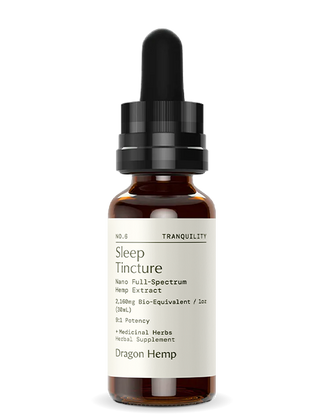
Dragon Hemp’s Sleep Tincture, Sleep Gummies, and Sleep Gummies+ combine CBD and CBN because most people with chronic sleep disruption need both mechanisms, not one.
Table of Contents
The Short Answer: CBN and CBD are both cannabinoids derived from hemp, but they work through completely different mechanisms. CBD is non-intoxicating and primarily modulates the serotonin system, TRPV1 channels, and the body’s own endocannabinoids — making it most effective for anxiety, inflammation, and the nervous system upstream of sleep. CBN is a partial CB1 receptor agonist generated when THC oxidizes and ages, with mild sedative properties that act directly on sleep architecture. CBD does not make you sleepy. CBN does — gently. Most people with chronic sleep disruption benefit from both, which is why practitioner-formulated sleep products combine them.
The question I hear most often in clinic is not “what is CBN” or “what is CBD.” It is some variation of the same underlying confusion: I tried one and it didn’t work. Should I try the other? The answer is almost always that the wrong tool was matched to the wrong problem. CBN and CBD occupy different functional categories. They are not interchangeable, not additive in the way most people assume, and not in competition. Once you understand what each compound is actually doing in the body, the choice between them becomes a clinical question with a clear answer.
CBN stands for cannabinol. It is not a primary cannabinoid the cannabis plant synthesizes directly — it is what THC becomes when THC oxidizes through prolonged exposure to heat, light, and air. In a fresh hemp flower, CBN content is negligible. In an aged sample, it climbs as the THC content breaks down.
This origin story is where most of the public confusion begins. The folklore that “CBN makes you sleepy because old weed makes you sleepy” traces back to a 1975 study by Karniol et al. that combined CBN with THC and attributed the sedative effect to CBN alone. The methodology was flawed — the sedation was likely coming from the THC, not the CBN — and it took the field decades to correct the record. The result is that for fifty years, CBN was treated as an afterthought: a degradation product, not a clinical compound in its own right.
Modern research has reopened the question. CBN is a partial agonist at the CB1 receptor, meaning it binds the same receptor THC binds but with substantially weaker effect. Functional doses in the 10–25mg range do not produce intoxication or the cognitive impairment associated with THC. The receptor activity is real but constrained. Most users describe the felt experience as a deep, settled relaxation rather than a high.
Importantly, the CBN sold in hemp-derived products is not extracted from aged THC stockpiles. Reputable manufacturers convert hemp-derived CBD into CBN through controlled isomerization or oxidation, producing a Farm Bill compliant cannabinoid with verifiable purity. The supply chain matters here, because CBN’s chemical relationship to THC means it can technically be produced from sources that raise regulatory questions hemp-derived CBN does not.
CBD stands for cannabidiol. It is non-intoxicating, and — this is the single most important fact about how CBD works — it does not bind CB1 directly. Almost every other claim about CBD’s mechanism follows from this one.
The pathways CBD does engage are different in kind from CB1 agonism. It is a partial agonist at the 5-HT1A serotonin receptor, modulates the TRPV1 channel involved in pain and inflammation signaling, and inhibits the reuptake of anandamide — which amplifies the body’s own endocannabinoid signaling without flooding the system with an exogenous CB1 agonist. There is also indirect allosteric modulation of CB1 and CB2, which softens THC’s effects when the two compounds are taken together. None of these mechanisms produce sedation in the way a hypnotic medication does. They produce regulation. The nervous system settles, anxiety drops, cortisol comes down, and the conditions for sleep emerge — but CBD is not the agent that puts you under.
This is why the most common complaint about CBD is that “it doesn’t feel like anything.” That is correct. At functional doses, CBD is felt subtly and cumulatively — a softening of the day’s residue across two to three weeks of consistent use — not as an acute event. The large 2019 case series published in The Permanente Journal tracked 72 adults receiving CBD for anxiety and sleep complaints. Within the first month, 79% had reduced anxiety scores. Sixty-seven percent showed improved sleep — but the anxiety improvement preceded and appeared to drive the sleep improvement. CBD was not initiating sleep. It was removing the upstream obstacle to sleep.
The people I see in clinic who report that CBD “made them sleepy” are responding to that downstream effect. The nervous system quieted, the parasympathetic took over, and sleep became possible. That is not the same thing as a sedative — and it matters, because the downstream effect of CBD is exactly what most modern sleep failure needs and exactly what most CBN-only products miss.
When someone walks into my clinic with a sleep complaint and asks why their CBD product is not working, the conversation almost always returns to this section. The mechanism distinctions are worth being precise about, because almost all of the practical differences flow from them.
At CB1, CBN is a partial agonist with mild direct activity. CBD is non-binding at this receptor — it does not activate CB1 in the canonical agonist sense. At CB2, both compounds interact, but neither is a primary driver of clinical effects in the dose ranges we are discussing. At 5-HT1A, CBD is a strong agonist; CBN’s activity is minimal. At TRPV1, CBD is a meaningful modulator; CBN’s effect is minor. Anandamide reuptake inhibition is a CBD mechanism, not a CBN mechanism — meaning CBD amplifies the body’s existing endocannabinoid tone, while CBN does not.
The most important divergence is at sleep architecture itself. The 2024 University of Sydney polysomnography study measured CBN’s direct effect on sleep in rats, with continuous EEG, EMG, and EOG recording. CBN increased both NREM and REM sleep, with the NREM effect comparable in magnitude to zolpidem — but without the REM suppression that hypnotic medications produce. CBD does not have comparable direct architecture effects in the same model. CBD’s contribution to sleep is upstream, through anxiety and nervous-system regulation; CBN’s contribution is at the architecture layer itself, where sleep depth and continuity are governed.
The way I frame it for the people I see in clinic: CBN works in the receptor system that THC works in, just more quietly. CBD works through an entirely different system, which is why it doesn’t feel like anything in the moment but reshapes how the day lands once it has been in your tissue for a few weeks.
The comparison is easier to see laid out directly.
CBD |
CBN |
||
Primary mechanism |
5-HT1A, TRPV1, anandamide modulation
|
Partial CB1 agonism |
|
|
Intoxicating? |
No |
No at functional doses |
|
|
Sedative? |
No (indirect, via anxiety relief) |
Yes, mildly and directly |
|
|
Best for |
Anxiety, stress, racing mind, daytime inflammation
|
Sleep maintenance, nighttime awakenings |
|
|
Onset of perceived effect |
Subtle, cumulative over days to weeks
|
Acute — felt within 30-60 minutes |
|
TCM analog |
Liver Qi smoothing, clearing constraint
|
Yin-anchoring, settling Heart-Shen |
|
Pairs well with |
CBN, THC, CBG, CBC, Chinese herbs |
CBD, THC microdose, Suan Zao Ren Tang & other Chinese Herbs
|
|
Dragon Hemp products |
Calming Gummies, Wellness Tincture, Sleep Tincture, Sleep Gummies, Sleep Gummies+, Leisure Gummies, Recovery Tincture
|
The table makes the point cleanly: these are not two formulations of the same drug. They are two different drugs that happen to be derived from the same plant.
Sleep, in Traditional Chinese Medicine, is not a single state. It is a sequence — a descent from Yang (active, bright, daytime) into Yin (quiet, dark, restorative), followed by the anchoring of the Heart-Shen in that settled state, followed by the deep restorative work of the Liver during the third watch of the night between 1 and 3 AM. Each phase of the arc has its own physiology, and each phase has its own failure modes.
CBD aligns with the descent phase. This is the territory of the racing mind — too much arousal to settle, too much heat at the surface to allow the system to turn inward. In TCM terms, it is excess Yang that has not been cleared, Liver Qi that is constrained and stagnant, Heart Fire that has not been brought down. CBD is well-suited to this phase because its mechanism — serotonin modulation, anandamide amplification, nervous-system regulation — is precisely what clearing excess Yang and smoothing Liver Qi looks like in modern pharmacology. The person who lies in bed for an hour with thoughts racing is the person CBD is built for.
CBN aligns with the anchoring phase. This is the territory of the 3 AM wake-up — the system made it into Yin but could not hold there, the Heart-Shen unmoored from its settled state, the deep cycles fragmenting before the night completes its restorative work. CBN’s direct effect on sleep architecture, measurable in polysomnography, is what Yin-anchoring looks like at the receptor level. The person who falls asleep adequately but wakes at 2:30 AM and stares at the ceiling is the person CBN is built for.
Different symptoms are different points of failure in the same arc. CBD fits the entry problem. CBN fits the maintenance problem. The combination addresses both phases — which is why most practitioner-formulated sleep products combine them. For a deeper read on the sleep-specific application of these two compounds, see our companion article on CBD or CBN for sleep.
This is the question most readers actually need answered, so I will be direct.
Use CBD alone if anxiety is the dominant problem, sleep is intact, and you need daytime functionality. Also CBD alone for inflammation, recovery support, and the general nervous-system regulation that benefits people running on chronic cortisol. The format matters less than the dose; tinctures and gummies both work, with gummies offering more sustained release.
Use CBN alone if sleep maintenance is the only problem — you fall asleep fine but wake at 2 or 3 AM and cannot return. Also CBN alone for people who cannot tolerate THC but need something more direct than CBD provides. CBN alone is the right tool when the upstream nervous-system layer is already functional and the only failure point is architecture.
Use both if the sleep disruption is layered — difficulty falling asleep and difficulty staying asleep, anxiety driving the inability to wind down combined with maintenance failure once you are finally under. This is the most common chronic-insomnia presentation I see in clinic, and it is why the formulation logic behind Sleep Gummies combines 25mg CBD and 10mg CBN in a single product.
Add a THC microdose (2.5mg) if even the CBD/CBN combination is not enough — usually for chronic insomnia with significant maintenance failure that has not responded to CBD/CBN alone. Sleep Gummies+ territory. The THC layer adds an additional architecture-stabilizing mechanism without crossing into intoxication at the 2.5mg dose. The in-depth review of the three sleep cannabinoids covers the full layered protocol.
Add Suan Zao Ren Tang (the TCM herbal layer) if the disruption is chronic, root-level, and reaching for a deeper kind of restoration than cannabinoids alone can deliver. This is the territory of Liver Blood deficiency, Yin depletion, and the kind of sleep failure that has been compounding for years. Sleep Tincture was formulated precisely for this presentation — the Suan Zao Ren Tang protocol explains the herbal framework in depth.
Formulated to ground the nervous system and invite a quiet, steady calm.
This peaceful blend of CBD isolate and CBN—ingredients selected to ease evening tension and guide your body back to its natural rhythm without THC—invites truly restorative sleep so you wake clear-headed and refreshed.
Because addressing the root of restlessness while preserving clarity is the first step toward waking as your true self.
Formulated to ground the nervous system and quiet a restless mind.
This precisely balanced blend of CBD, CBN, and micro-dosed THC—ingredients selected to shorten the time it takes to wind down and support a deeper state of rest—helps ease evening tension so you wake clear and refreshed.
Because guiding your transition into rest is the first step to a deeper, fuller night of truly restorative sleep.
Practitioner-formulated to restore the balance necessary for a full, deep sleep cycle.
This high-potency tincture draws from time-honored 'Suan Zao Ren Tang' formulas, blending traditional Chinese herbs—long-trusted to settle a restless mind and nourish the spirit—with nano-encapsulated CBD & CBN to target the racing thoughts and midnight wakefulness that disrupt your rest. By helping you stay asleep longer, it ensures your body reaches the deep cycles essential for systemic recovery and physical restoration.
Because a full night of sleep is about more than just rest—it’s about waking with the energy and focus to feel like yourself again.
Both CBN and CBD are federally Farm Bill compliant when hemp-derived (less than 0.3% THC by dry weight). State-level laws vary, and CBN’s relationship to THC occasionally generates regulatory confusion that CBD does not face, but hemp-derived CBN products are legal in the vast majority of U.S. jurisdictions. Avoid any product that claims it is “100% legal everywhere” — that is marketing language, not a regulatory reality.
A note on drug testing for the people who care about it — athletes, professionals in regulated industries, anyone subject to workplace screening. Full-spectrum hemp products contain trace THC under the 0.3% threshold, which can in rare cases register on a sensitive panel. If that is a concern, a broad-spectrum or isolate formulation with a Certificate of Analysis showing non-detectable THC is the safer choice.
The quality benchmarks are the same for both compounds: a current Certificate of Analysis from a third-party laboratory, a full cannabinoid panel showing verified content (not just “broad spectrum” with trace amounts), contaminant testing for heavy metals, pesticides, and residual solvents, and clear sourcing disclosure. Cheap CBN products often contain unconverted CBD that has been mislabeled, or use isolate without the entourage compounds that potentiate the effect.
The standard I would hold any sleep product to before recommending it in clinic is: a verified dose in the functional range, paired with the cannabinoid combination that addresses the actual mechanism of the person’s sleep failure, formulated by someone who understands the difference between architecture and onset. That is the standard the Dragon Hemp formulations were built to meet.
The pattern I see most often in clinic — and the pattern that drives most of Dragon Hemp’s formulation work — is not “anxiety” or “insomnia” in isolation. It is the layered version of both: a nervous system that cannot quiet itself, sitting on top of a sleep architecture that cannot hold. CBD addresses the first layer. CBN addresses the second. Neither, on its own, is a complete protocol. But used in combination — and especially when paired with the right TCM herbal foundation — they cover the actual mechanism of how most modern sleep disruption unfolds. The question is not whether CBN is “better than” CBD. The question is what your body is actually doing wrong, and which tool fits which failure.
Direct Answer: CBN is more directly sedating than CBD, but “stronger” is the wrong frame — they work on different systems. CBN binds CB1 receptors (mildly) and produces a felt sedative effect. CBD does not bind CB1 and does not directly sedate.
Clinical Context: This question usually comes from people expecting cannabinoids to fall on a single potency axis, the way alcohol does. They do not. CBD and CBN occupy different functional categories. Asking which is stronger is like asking whether ibuprofen is stronger than melatonin — the comparison does not translate. Match the compound to the mechanism.
Direct Answer: No. CBN is mildly psychoactive at the receptor level — it is a partial CB1 agonist — but functional sleep doses (10–25mg) do not produce intoxication, euphoria, or the cognitive impairment characteristic of THC.
Clinical Context: The structural similarity between CBN and THC creates persistent confusion. They share the parent molecule — CBN is what THC becomes when it oxidizes. But the partial agonism is too mild to cross the threshold of perceived intoxication. The receptor binding is real; the felt experience is closer to a deep relaxation than a high.
Direct Answer: Yes — and most clinical sleep formulations are designed to combine them precisely because they address different phases of sleep. CBD modulates the nervous system entry into sleep; CBN stabilizes the architecture once you are there.
Clinical Context: The two compounds are not additive in the sense of producing a stronger version of the same effect. They are complementary in the sense of covering different mechanisms. This is the formulation logic behind Dragon Hemp’s Sleep Gummies, which deliver CBD and CBN in a single product because most chronic sleep disruption has both an onset layer and a maintenance layer.
Direct Answer: CBN is generally well-tolerated at functional doses. Reported side effects are typically mild — drowsiness extending into the morning if dosed too high, mild dry mouth, or occasional gastrointestinal sensitivity. Drug interactions exist via the CYP enzyme system and should be discussed with a prescriber for anyone on prescription medications.
Clinical Context: Most of what the internet attributes to “CBN side effects” is actually carryover sedation from overdosing — taking 25mg or more when 10mg would have been sufficient. Start low, titrate up, and find the dose where the effect is contained to the night. Our companion article on CBN dosing and tolerance covers this in more depth.
Direct Answer: CBN derived from hemp is federally Farm Bill compliant in the United States, like CBD. State-level laws vary slightly, and CBN’s relationship to THC (it is a degradation product) occasionally generates regulatory confusion, but CBN-from-hemp products are legal in the vast majority of U.S. jurisdictions.
Clinical Context: Avoid CBN products that do not disclose source or testing. The supply chain matters because CBN can technically be produced from THC oxidation, and that path raises legal questions hemp-derived CBN does not. Look for a Certificate of Analysis confirming the source.
Direct Answer: Melatonin is a hormone that signals the brain it is time to begin the sleep transition. CBN is a cannabinoid that acts on CB1 receptors to stabilize sleep architecture once you are already asleep. Melatonin helps you fall asleep. CBN helps you stay asleep.
Clinical Context: Many people use melatonin without realizing it does not address sleep maintenance — it addresses sleep onset and circadian timing. If your problem is waking at 3 AM, melatonin is the wrong tool. CBN is closer to the right one. Our companion article on CBN vs melatonin goes deeper on this distinction.
Direct Answer: CBN does not appear to build the kind of tolerance THC builds, and there is no evidence of dependence at functional sleep doses. Most people use CBN nightly without issue. As with any sleep aid, periodic re-evaluation is wise.
Clinical Context: A cannabinoid that masks chronic sleep failure without addressing why the sleep is failing is a temporary solution. CBN works at the architecture layer. If you still need it nightly after several months, the question becomes what is driving the underlying instability — usually a root-cause TCM diagnosis (Liver Blood deficiency, Heart-Shen disturbance, Yin depletion) that benefits from herbal support beyond cannabinoids alone.
Dragon Hemp was established by Kevin Menard, LAc, a specialist in Sports Medicine Acupuncture and Traditional Chinese Medicine. Developed in his Sag Harbor clinic, our formulations bridge the gap between ancient herbal wisdom and modern cannabinoid research to address the root causes of pain, sleep, and wellness issues.
From our Rest & Restoration and Essential Wellbeing collections to our targeted Aches & Pains topicals, every product is formulated with organically grown botanicals and premium hemp extracts. We invite you to experience our sophisticated fusion of tradition and innovation at our flagship apothecary at 108 Main Street, Sag Harbor, or explore our full range of tinctures, gummies, and balms online.
Kevin Menard, LAc.
Kevin Menard, LAc., is the founder of Dragon Hemp and a licensed acupuncturist specializing in Sports Medicine Acupuncture and Traditional Chinese Medicine. He practices at his Sag Harbor clinic, where Dragon Hemp’s formulas are developed alongside his clinical work. His protocols integrate classical Chinese herbal medicine with modern cannabinoid research.