







CBD or CBN for Sleep; Which is Better?
The Short Answer: Neither CBD nor CBN is universally better for sleep — they address different phases of different sleep problems. CBD works primarily through anxiety reduction, cortisol modulation, and nervous system regulation, making it most effective for difficulty falling asleep driven by stress or a racing mind. CBN works through partial CB1 receptor agonism to stabilize sleep architecture, making it most effective for nighttime awakenings and sleep maintenance. Most people with chronic insomnia have elements of both problems — which is why combining them in a properly formulated product outperforms choosing one. The distinction is not which is stronger. It is which mechanism matches your pattern.
The question "CBD or CBN for sleep?" implies that one is better than the other — that there is a correct answer, and choosing wrong means leaving results on the table.
The more useful question is: what is actually disrupting your sleep? The answer to that question determines which compound — or combination — is clinically appropriate. CBD and CBN are not competing sleep aids. They are tools with different mechanisms that address different phases of a problem most people experience simultaneously.
How CBD Works for Sleep
CBD does not sedate. This is the most important thing to understand about it as a sleep compound. It does not produce drowsiness, does not suppress wakefulness signals, and does not directly initiate sleep the way a prescription sleep aid does. What it does is address several of the most common reasons sleep fails to occur or remain stable.
CBD is an agonist of the serotonin 5-HT1A receptor and modulates activity at TRPV1 channels — mechanisms that reduce anxiety, quiet stress-related neurological activation, and support fear extinction. It also inhibits the reuptake of anandamide, the body's primary endocannabinoid, amplifying the endocannabinoid system's own calming activity. Through these pathways, CBD reduces the cortisol elevation and sympathetic nervous system overactivation that are the most common physiological reasons sleep onset is delayed.
The clinical evidence supports this anxiety-first mechanism. A large case series published in PMC found that in 103 adult patients using CBD for anxiety or sleep, anxiety scores decreased in 79% of patients within the first month, and sleep scores improved in 67% — with anxiety improvement preceding and appearing to drive the sleep improvement. CBD's sleep benefit is largely downstream of its anxiety and nervous system regulation effect.
In TCM terms, CBD's action corresponds most closely to the regulatory function of the Liver — smoothing the flow of Qi, reducing the constraint and stagnation that generate Heat and arousal, and allowing the nervous system to descend into the Yin state that sleep requires. It does not nourish what is depleted. It clears what is excessive and stuck.
How CBN Works for Sleep
CBN works through a different mechanism entirely — partial CB1 receptor agonism that directly modifies sleep architecture rather than addressing the nervous system state upstream of it.
A 2024 polysomnography study from the University of Sydney found that CBN increased both NREM and REM sleep in rats, with the NREM effect comparable in magnitude to the prescription sleep drug zolpidem — and unlike zolpidem, without suppressing REM sleep. This is the first objective sleep architecture data on CBN, and it meaningfully differentiates CBN from other cannabinoids and most pharmaceutical sleep aids.
On the human clinical side, a double-blind, placebo-controlled trial found that 20mg CBN nightly significantly reduced nighttime awakenings and overall sleep disturbance in 293 poor-quality sleepers — without affecting daytime fatigue. The effect was specific: fewer awakenings, less disturbance through the night. It was not a broad sedative effect.
In TCM terms, CBN's action corresponds to the stabilizing, Yin-anchoring quality needed in the night's second half — the period when the Heart-Shen must remain settled and the Liver completes its restorative work. It does not clear excess. It provides the structural support that allows the body to hold the state it has entered.
Why They Are Complementary, Not Competing
The reason most people with chronic insomnia benefit from both CBD and CBN is that their sleep problem has multiple layers. The anxiety and cortisol dysregulation that delays sleep onset is a different mechanism from the sleep architecture instability that causes nighttime awakenings. CBD addresses the first layer. CBN addresses the second.
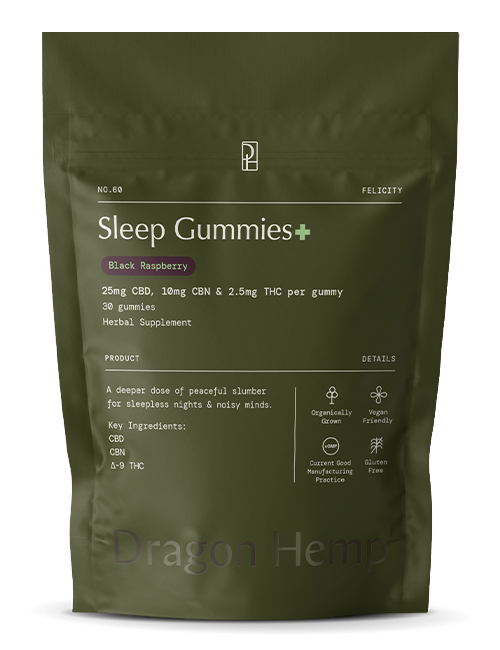
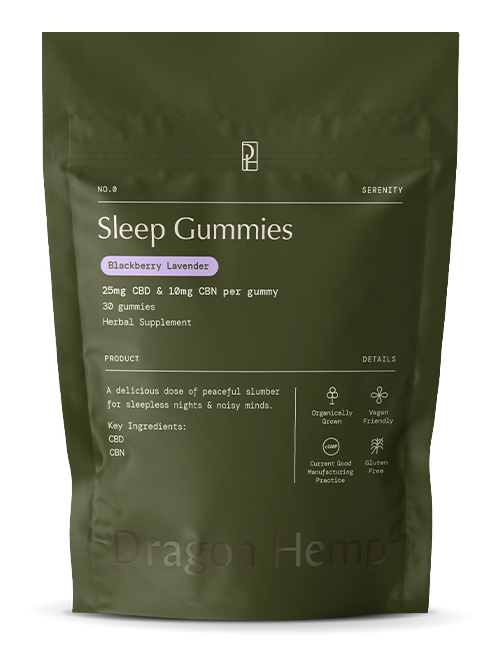
This is why Dragon Hemp's Sleep Gummies combine both — 25mg CBD and 10mg CBN — in a THC-free formula. CBD handles the nervous system regulation and anxiety layer; CBN handles the sleep maintenance and architecture layer. The two compounds are not additive in the sense of producing a stronger version of the same effect. They are complementary in the sense of covering different phases of the same problem.
Which One Should You Start With?
The answer depends entirely on your sleep pattern.
If your primary problem is difficulty falling asleep — lying awake with a racing mind, elevated stress, or anxiety at bedtime — CBD is the more directly targeted compound. It addresses the nervous system activation that is preventing sleep onset. The sleep problem here is upstream of sleep architecture; it is a failure to transition from the day's sympathetic state into the Yin required for rest.
If your primary problem is waking in the middle of the night — falling asleep adequately but finding yourself awake at 3 AM and unable to return — CBN is the more directly targeted compound. It addresses the sleep maintenance and architecture layer that CBD does not specifically reach. In TCM, this is the Liver's peak hour, when excess Liver Heat disturbs the Heart-Shen and cortisol begins its premature early-morning rise.
If you have both problems — which is true of most people with chronic insomnia — the combination makes clinical sense. This is the logic behind Dragon Hemp's Sleep Gummies, which deliver both cannabinoids in a single formulation for exactly this reason. For those with a more pronounced maintenance problem, Sleep Gummies+ adds 2.5mg THC to the same CBD and CBN base, providing additional sedation through the night's most critical maintenance window without crossing into the dose range that suppresses REM sleep or builds meaningful tolerance.
What Neither CBD Nor CBN Can Do Alone
Both compounds address layers of the sleep problem. Neither addresses the root cause.
In TCM, most chronic insomnia reflects Liver Blood deficiency with Heart-Shen disturbance — a depleted system that generates excess arousal because the nourishing, cooling, anchoring resources are insufficient. CBD can clear the surface excess. CBN can stabilize the architecture. But neither nourishes the Liver Blood that the Heart-Shen needs to settle into true rest.
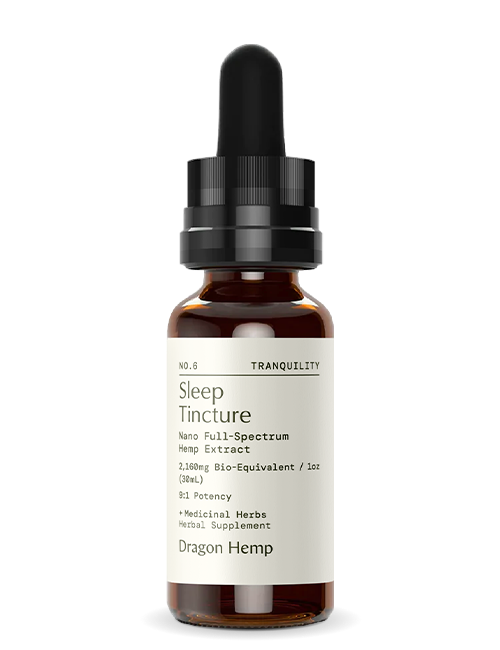
Suan Zao Ren Tang — the classical five-herb TCM formula in Dragon Hemp's Sleep Tincture — works at this root level, through GABA-A and serotonergic pathways that neither CBD nor CBN access. The Sleep Tincture combines full-spectrum CBD and CBN with Suan Zao Ren Tang in a nano-emulsified format that delivers fast onset (15–30 minutes) while the herbal matrix sustains the restorative effect through the full night. For a deeper explanation of the formula, see What is Suan Zao Ren Tang?.
The complete sleep protocol — Sleep Tincture as the nightly foundation, Sleep Gummies or Sleep Gummies+ for targeted cannabinoid support — addresses all three layers simultaneously: nervous system regulation, sleep architecture stabilization, and root-cause Liver Blood nourishment. For the full protocol and timing, see the nightly restoration protocol.
Buy 2 CBN products & save 10%.
Buy 3 & save 15%.
Is CBD or CBN better for sleep?
Direct Answer
Neither is universally better — they target different phases of different sleep problems. CBD is more effective for difficulty falling asleep driven by anxiety, stress, or an overactive mind. CBN is more effective for nighttime awakenings and sleep maintenance. Most people with chronic insomnia benefit from both, which is why Dragon Hemp's Sleep Gummies combine 25mg CBD and 10mg CBN in a single formulation.
Clinical Context
The question "which is better" assumes they are competing for the same mechanism. They are not. CBD works upstream — regulating the nervous system state that determines whether sleep can begin. CBN works within the sleep window — stabilizing the architecture that determines whether it can be sustained. The two compounds cover different phases of the same problem, which is why combining them produces more complete sleep support than choosing one.
What does CBD do for sleep?
Direct Answer
CBD reduces anxiety, modulates cortisol, and regulates nervous system activation through serotonin 5-HT1A receptor agonism, TRPV1 modulation, and anandamide reuptake inhibition. Its sleep benefit is primarily upstream — it addresses the anxiety and stress-driven arousal that delays sleep onset, rather than directly initiating sleep.
Clinical Context
This is why CBD works best for people whose primary sleep problem is difficulty falling asleep — lying awake with a racing mind, elevated cortisol from unresolved daily stress, or anxiety that won't quiet at bedtime. It is not a sedative. It is a nervous system regulation compound whose sleep benefit flows from its anxiety-reducing effect. In a significant clinical case series, anxiety improvement preceded and appeared to drive sleep improvement in patients using CBD.
What does CBN do for sleep?
Direct Answer
CBN acts as a partial CB1 receptor agonist to stabilize sleep architecture — increasing NREM and REM sleep and reducing nighttime awakenings. A 2024 polysomnography study found its effect on NREM sleep comparable to zolpidem, without the REM suppression that zolpidem and high-dose THC produce. A double-blind human trial found 20mg CBN significantly reduced nighttime awakenings without affecting daytime fatigue.
Clinical Context
CBN's clinical strength is specificity. It does not produce broad sedation. It targets the maintenance layer — keeping sleep stable through the night rather than simply initiating it. This makes it the most appropriate cannabinoid for the 3 AM waking pattern, where the nervous system activation driving wakefulness occurs mid-sleep rather than at bedtime.
Can I take CBD and CBN together for sleep?
Direct Answer
Yes — and for most people with chronic insomnia, combining them makes clinical sense. CBD addresses the onset layer; CBN addresses the maintenance layer. They work through different mechanisms that cover complementary phases of the sleep problem. Dragon Hemp's Sleep Gummies deliver both in a single THC-free formula for exactly this reason.
Clinical Context
A 2024 RCT found that adding CBD to CBN did not augment CBN's specific effect on nighttime awakenings — which is consistent with the mechanistic picture, since CBD does not work through CBN's CB1 sleep architecture pathway. But this finding says nothing about what CBD contributes independently, which is substantial: the nervous system regulation that allows sleep to begin in the first place. The two compounds address different questions. Measuring whether one augments the other's specific outcome misses the point of combining them.
Which is better for anxiety-related insomnia — CBD or CBN?
Direct Answer
CBD is more directly targeted for anxiety-related insomnia. Its mechanism — serotonin 5-HT1A agonism, cortisol modulation, anandamide amplification — addresses the nervous system activation that anxiety drives. CBN's partial CB1 agonism does not directly target anxiety the way CBD does.
Clinical Context
That said, anxiety and sleep maintenance problems frequently coexist. Anxiety raises cortisol, which delays sleep onset and then triggers early-morning waking as cortisol continues its rise. CBD addresses the cortisol and anxiety layer; CBN addresses the maintenance layer that cortisol dysregulation disrupts. A complete protocol addresses both, which is why Dragon Hemp's Sleep Gummies combine the two rather than asking one compound to do everything.
Does CBN work better than CBD for staying asleep?
Direct Answer
Yes, for sleep maintenance specifically. CBN's documented clinical benefit is reducing nighttime awakenings — the central sleep maintenance problem. CBD's documented benefits are more upstream: anxiety reduction and nervous system regulation that support sleep onset. For staying asleep through the night, CBN is the more directly targeted compound.
Clinical Context
This is the clinically important distinction that most product marketing obscures. CBD is frequently marketed as a sleep aid without specifying that its sleep benefit is primarily onset-related and anxiety-mediated. CBN's maintenance-specific effect is more recently documented but more targeted to the problem most chronic insomnia sufferers find hardest to solve — not falling asleep, but staying asleep through the 3 AM window.
How much CBD and CBN should I take for sleep?
Direct Answer
Dragon Hemp's Sleep Gummies deliver 25mg CBD and 10mg CBN per gummy — a clinically relevant dose of both compounds in a single formulation. Start with one gummy 45–60 minutes before bed and assess over five to seven nights before adjusting. Two gummies approach the 20mg CBN dose used in the clinical trial for those with more significant maintenance problems.
Clinical Context
The 25mg CBD dose aligns with the range shown to improve sleep in anxiety-driven insomnia. The 10mg CBN per gummy delivers meaningful maintenance support, with two gummies reaching the trial dose for those whose primary problem is nighttime awakenings. Consistency across five to seven nights matters more than dose precision within a therapeutic range — the ECS adapts to sustained, predictable stimulation rather than one-off high doses.
Is CBN psychoactive?
Direct Answer
No, at therapeutic sleep doses. CBN has weak direct CB1 receptor affinity — approximately ten times less potent than THC — and does not produce meaningful psychoactivity at the doses used in clinical sleep research. The 293-participant CBN trial reported no significant psychoactive effects at 20mg.
Clinical Context
Very high doses of CBN can produce mild THC-like effects, as early research documented. At therapeutic sleep doses — 10 to 20mg — this is not a practical concern. Dragon Hemp's Sleep Gummies are THC-free, making them the appropriate choice for those who want CBN and CBD support without any psychoactive component. Sleep Gummies+ adds a precise 2.5mg THC for those who need additional sedation for the maintenance layer.
Practitioner-Founded.
Rooted in Clinical Expertise.
Dragon Hemp was established by Kevin Menard, LAc, a specialist in Sports Medicine Acupuncture and Traditional Chinese Medicine. Developed in his Sag Harbor clinic, our formulations bridge the gap between ancient herbal wisdom and modern cannabinoid research to address the root causes of pain, sleep, and wellness issues.
From our Rest & Restoration and Essential Wellbeing collections to our targeted Aches & Pains topicals, every product is formulated with organically grown botanicals and premium hemp extracts. We invite you to experience our sophisticated fusion of tradition and innovation at our flagship apothecary at 108 Main Street, Sag Harbor, or explore our full range of tinctures, gummies, and balms online.
-
Learn more about our botanicals in our Ingredients Index.
- Discover the design and ethos of our Sag Harbor apothecary in Forbes.


Explore community favorites

A foundational ritual for daily resilience and systemic balance.
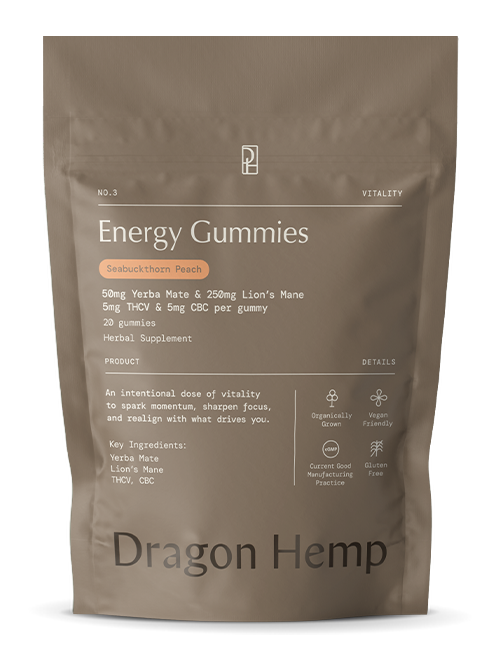
A clean-burning herbal boost for immediate clarity and momentum.
Feel like yourself again.
Peruse our collection of plant-based therapeutics blending time-honored herbal remedies with next-generation cannabinoid extracts.